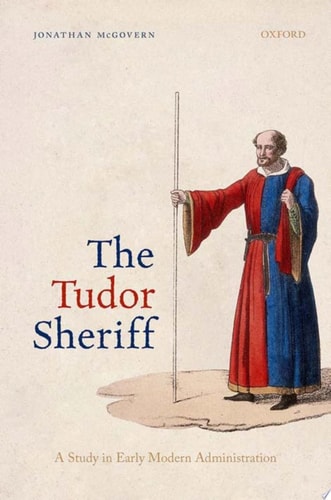
The Tudor Sheriff: A Study in Early Modern Administration
0
0
As an Amazon Associate and affiliate partner, Menrva Books earns from qualifying purchases. Learn more
Author Description
Sheriffs were among the most important local office-holders in early modern England. They were generalist officers of the king responsible for executing legal process, holding local courts, empanelling juries, making arrests, executing criminals, collecting royal revenue, holding parliamentary elections, and many other vital duties. Although sheriffs have a cameo role in virtually every book about early modern England, the precise nature of their work has remained something of a mystery.The Tudor Sheriff offers the first comprehensive analysis of the shrieval system between 1485 and 1603. It demonstrates that this system was not abandoned to decay in the Tudor period, but was effectively reformed to ensure its continued relevance. Jonathan McGovern shows that sheriffs were not in competition with other branches of local government, such as the Lords Lieutenant and justices of the peace, but rather cooperated effectively with them. Since the office of sheriff was closely related to every other branch of government, a study of the sheriff is also a study of English government at work.
Menrva's Summary
THE THESIS
This work investigates the operational mechanics and administrative evolution of the shrieval system in England between 1485 and 1603. Jonathan McGovern utilizes archival records and historical analysis to challenge the prevailing notion that the office of the sheriff declined during the Tudor era. He argues that the system underwent significant reform to maintain its functionality and integration within the broader framework of local governance.
THE SCOPE MAP
What You Will Find
- Analysis of legal processes, jury empanelling, and revenue collection duties.
- Examination of the collaborative relationship between sheriffs, Lords Lieutenant, and justices of the peace.
- Historical overview of the shrieval system from the ascension of Henry VII to the death of Elizabeth I.
Scope Limits
- The study focuses specifically on the English shrieval system and does not extend to comparative administrative studies in other European nations.
- The research is confined to the Tudor period and does not provide a detailed analysis of post-1603 administrative shifts.
THE AUTHORITY PERSPECTIVE
Historians identify this work as a significant contribution to the understanding of early modern English governance. Readers frequently note the clarity with which the author synthesizes complex administrative data into a coherent institutional history.
Page Count:
320
Publication Date:
2022-04-21
Publisher:
Oxford University Press
ISBN-10:
0192848240
ISBN-13:
9780192848246
History
Europe
Early Modern
Public Administration
Legal History
Administration of Justice
Sheriffs
Tudor Period
Community Tags
Similar Books