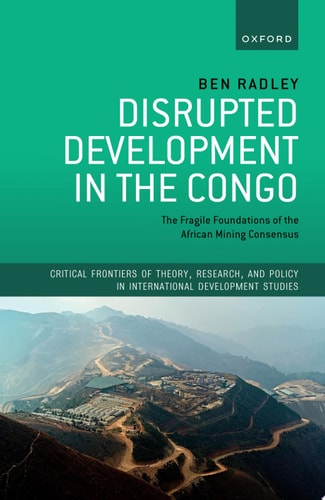
Disrupted Development in the Congo: The Fragile Foundations of the African Mining Consensus
0
0
As an Amazon Associate and affiliate partner, Menrva Books earns from qualifying purchases. Learn more
Author Description
Since the turn of the century, low-income African countries have undergone a process of mining industrialization led by transnational corporations. The process has been sustained by an African Mining Consensus uniting international financial institutions, African governments, development agencies, and various strands of the academic literature. The Consensus position is that mining industrialization can drive transformative processes of social and economic development in low-income African settings. For this, state-owned enterprises and local forms of labour-intensive mining are deemed unsuitable. The former is characterized as corrupt and mismanaged, and the latter as an inefficient, subsistence activity with links to conflict financing. The Consensus holds, instead, that mining industrialization should be led by the superior expertise and efficiency of transnational corporations.Disrupted Development in the Congo reveals the fragile foundations on which this Consensus rests. Through an in-depth case study of mining in the Democratic Republic of the Congo, Ben Radley details how foreign corporations have been prone to mismanagement, inefficiencies, and rent-seeking, and implicated in fuelling conflict and violence. He also documents how structural impediments to the transformative effects of mining industrialization in low-income African countries occur irrespective of ownership and management structures. Based on the findings presented, Radley urges a move away from the market-led logics underpinning the Consensus. In the mining sector itself, he argues that efforts to mechanize labour-intensive forms of local mining better meet the needs of low-income African economies for rising productivity, labour absorption, and the domestic retention of the value generated by productive activity than the currently dominant but disruptive foreign corporate-led model.Part of this title is published open access. This part is made available under a Creative Commons Attribution-N
Menrva's Summary
THE THESIS
This book investigates whether the prevailing African Mining Consensus—which prioritizes transnational corporate leadership in mining—actually facilitates sustainable social and economic development in low-income African nations. Ben Radley, a researcher in international development, utilizes a detailed case study of the Democratic Republic of the Congo to challenge the assumption that foreign-led industrialization is inherently superior to local or state-managed alternatives. He argues that the current model often results in rent-seeking and conflict rather than the promised transformative growth, proposing instead a shift toward mechanizing local, labour-intensive mining operations to better retain domestic value.
THE SCOPE MAP
What You Will Find
- Analysis of the African Mining Consensus framework and its proponents.
- A longitudinal case study of mining practices in the Democratic Republic of the Congo.
- Comparative evaluation of transnational corporate models versus local labour-intensive mining.
- Policy recommendations for increasing domestic productivity and value retention.
Scope Limits
- The analysis focuses primarily on the Democratic Republic of the Congo as a representative case study.
- The text does not provide a comprehensive survey of all mining operations across the entire African continent.
THE AUTHORITY PERSPECTIVE
Scholars in development studies identify this work as a critical intervention in the debate surrounding resource extraction and economic sovereignty. Readers frequently note the academic rigor of the research and its utility for policymakers seeking alternatives to market-led development models.
Page Count:
224
Publication Date:
2024-01-01
Publisher:
Oxford University Press
ISBN-10:
0192849050
ISBN-13:
9780192849052
NATURE Ecology
International relations
Community Tags
Similar Books