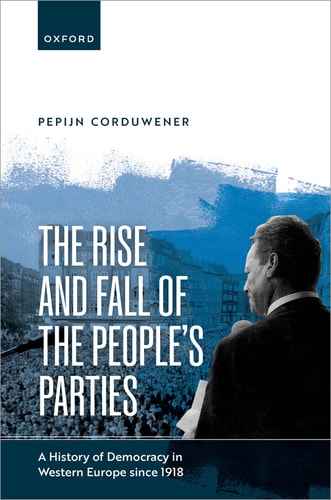
The Rise and Fall of the People's Parties: A History of Democracy in Western Europe since 1918
0
0
As an Amazon Associate and affiliate partner, Menrva Books earns from qualifying purchases. Learn more
Author Description
This is an open access title available under the terms of a CC BY-NC-ND 4.0 International licence. It is free to read on Oxford Academic and offered as a free PDF download from OUP and selected open access locations.Across Europe, people are deeply concerned about the state of democracy. The Rise and Fall of the People's Parties shifts the attention away from ever-changing populist politicians that capture newspaper headlines to the centre-left and centre-right people's parties that used to buttress the democratic order over the past decades, but which are now in steep decline. Why does the crisis of these parties contribute so profoundly to today's crisis of democracy? And why were these parties so important for the stabilization and legitimation of democracy in the past century in the first place?By providing a long-term and transnational account of the history of democracy in modern Europe, The Rise and Fall of the People's Parties reveals the striking parallels between the history of democracy and the history of the people's parties since 1918.The first part of the book shows how the failure to turn traditional working-class and confessional mass parties into people's parties played a vital role in the collapse of democracy in the 1920s and 1930s. It also explores the attractiveness of the people's party ideal centred on moderation, compromise and openness to pioneering politicians in the mid-century. The second part of the book then traces the practical application and breakthrough of this ideal in the decades after World War II and shows how this contributed to the stabilization and legitimation of democracy in the postwar decades. In the final part of the book, Corduwener turns to the slow decline of the people's parties since the mid-1970s. It explores how their failure to represent volatile and polarized societies was reflected in their aim to turn into 'open' and 'flexible' parties focused primarily on providing governmental efficiency - and how this event
Menrva's Summary
THE THESIS
This work investigates the historical correlation between the rise and decline of European 'people's parties' and the stability of democratic governance since 1918. Dr. Pepijn Corduwener, a historian specializing in modern European politics, utilizes a transnational comparative framework to argue that the institutional health of these mass-membership parties served as the primary mechanism for legitimizing democratic systems. By analyzing the shift from ideological mass parties to efficiency-oriented political organizations, the author demonstrates how the erosion of these structures has directly contributed to the contemporary crisis of democratic representation.
THE SCOPE MAP
What You Will Find
- A comparative analysis of centre-left and centre-right political party evolution across Western Europe.
- A historical timeline spanning from the interwar period of the 1920s and 1930s through the post-WWII stabilization era to the mid-1970s decline.
- An examination of the transition from class-based and confessional parties to broad-tent 'people's parties'.
- Theoretical frameworks regarding political moderation, compromise, and governmental efficiency.
Scope Limits
- The analysis focuses primarily on Western European nations, excluding detailed coverage of Eastern European political developments.
- The text does not provide a prescriptive guide for future political reform, focusing instead on historical causality and institutional analysis.
THE AUTHORITY PERSPECTIVE
Experts identify this text as a significant contribution to the study of European political history, noting its clear transnational approach to party development. Readers frequently highlight the academic rigor of the prose and the author's ability to synthesize complex historical data into a coherent narrative regarding democratic stability.
Page Count:
272
Publication Date:
2023-01-01
Publisher:
Oxford University Press
ISBN-10:
0192843419
ISBN-13:
9780192843418
History
20th Century
European History
Democracy
Community Tags
Similar Books