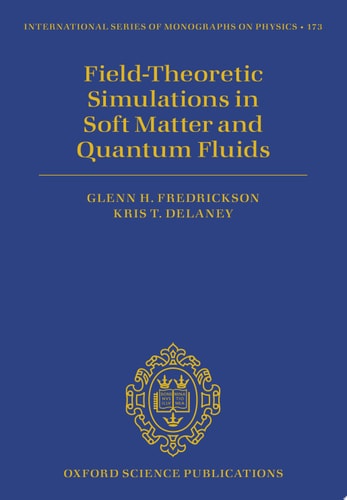
Field-Theoretic Simulations in Soft Matter and Quantum Fluids
0
0
As an Amazon Associate and affiliate partner, Menrva Books earns from qualifying purchases. Learn more
Author Description
This monograph provides an introduction to field-theoretic simulations in classical soft matter and Bose quantum fluids. The method represents a new class of molecular computer simulation in which continuous fields, rather than particle coordinates, are sampled and evolved. Field-theoretic simulations are capable of analysing the properties of systems that are challenging for traditional simulation techniques, including dense phases of high molecular weight polymers, self-assembling fluids, and quantum fluids at finite temperature.The monograph details analytical methods for converting classical and quantum many-body problems to equilibrium field theory models with a molecular basis. Numerical methods are described that enable efficient, accurate, and scalable simulations of such models on modern computer hardware, including graphics processing units (GPUs). Extensions to non-equilibrium systems are discussed, along with an introduction to advanced field-theoretic simulation techniques including free energy estimation, alternative ensembles, coarse-graining, and variable cell methods.
Menrva's Summary
THE THESIS
How can field-theoretic simulation methods overcome the computational limitations inherent in traditional particle-based molecular modeling for complex soft matter and quantum systems? Glenn H. Fredrickson and Kris T. Delaney present a comprehensive framework for transitioning from particle-coordinate simulations to continuous field-based models. By leveraging equilibrium field theory, the authors provide a rigorous mathematical and numerical foundation for analyzing high-molecular-weight polymers, self-assembling fluids, and quantum fluids at finite temperatures. The text serves as both a theoretical introduction and a practical guide for implementing these scalable simulations on modern hardware architectures.
THE SCOPE MAP
What You Will Find
- Analytical derivations for converting many-body problems into field theory models
- Numerical algorithms optimized for GPU-accelerated computing
- Advanced techniques including free energy estimation and coarse-graining
- Methodologies for non-equilibrium system analysis
Scope Limits
- Does not cover basic introductory statistical mechanics for undergraduate students
- Excludes experimental laboratory protocols or hardware-specific programming tutorials
THE AUTHORITY PERSPECTIVE
Experts recognize this monograph as a primary reference for researchers transitioning into field-theoretic simulation methods. Readers frequently note the high level of mathematical rigor and the technical density of the prose, which is intended for graduate-level physicists and computational scientists.
Page Count:
400
Publication Date:
2023-05-28
Publisher:
Oxford University Press
ISBN-10:
0192847481
ISBN-13:
9780192847485
Statistical mechanics
Physics
Quantum Fluids
Soft Matter
Community Tags
Similar Books