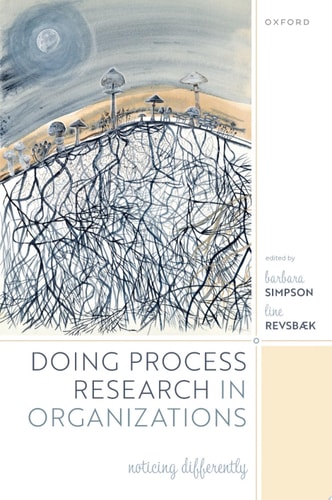
Doing Process Research in Organizations: Noticing Differently
0
0
As an Amazon Associate and affiliate partner, Menrva Books earns from qualifying purchases. Learn more
Author Description
This book takes up the challenge that process philosophy and process ontology pose to conventional, entity-based empirical research, even daring to question the relevance of 'methodology' in contemporary process organization studies. A process ontology demands reimagining and ongoing reinvention of how researchers inquire into and engage with the movements and moments of a morphing world. This in turn requires us to notice differently in our empirical engagements.Contributors to this book share a commitment to research that is more-than-representational in its concern to notice and act-with the latencies and diversities of living experience. Drawing inspiration from process philosophies, posthuman subjectivities, post qualitative inquiry, art, poetics, cinematics, and aesthetics, the chapters actively manifest the doing, reading, and writing of process research by attuning to occasions, moments, atmospheres, affects, agencements, with-ness, difference, and multiplicity. In bringing these ideas alive, the authors engage with their own empirical unfoldings by means of communing, corresponding, caring, performative writing, depersonalization, subject proliferation, mindfulness, relating, slow seeing, rhythmanalysis, listening, chromatic empiricism, and diffraction. Each chapter offers a unique worlding constituted in the particular elements it brings together, affording a style of reading that is oriented towards sensing rather than knowing or mastery. The chapters can be read in any order, alone or with and through each other. Collectively they evoke a mycelial web of resonance travelling across, between, and beyond the contents of this book.
Menrva's Summary
THE THESIS
This book investigates how researchers can adapt empirical inquiry to align with the fluid, non-linear nature of process ontology in organizational studies. The authors, Line Revsbæk and Barbara Simpson, challenge the traditional entity-based approach to research by proposing a shift toward 'noticing differently.' They argue that by integrating process philosophy, aesthetics, and post-qualitative methods, researchers can better capture the dynamic, morphing movements of organizational life rather than attempting to fix them into static representations.
THE SCOPE MAP
What You Will Find
- Theoretical frameworks derived from process philosophy and posthumanism
- Methodological approaches including rhythmanalysis, chromatic empiricism, and diffraction
- Explorations of sensory-based research techniques like slow seeing and mindful listening
Scope Limits
- Does not provide a standardized, step-by-step manual for traditional quantitative data collection
- Does not focus on conventional organizational management or corporate efficiency metrics
THE AUTHORITY PERSPECTIVE
Experts recognize this work as a significant contribution to the field of process organization studies, particularly for those seeking to move beyond representational research paradigms. Readers frequently note the high level of theoretical density and the experimental nature of the prose, which demands an active, reflective engagement from the researcher.
Page Count:
256
Publication Date:
2022-12-22
Publisher:
Oxford University Press
ISBN-10:
0192849638
ISBN-13:
9780192849632
Social Science
Management Theory
Process philosophy
Community Tags
Similar Books