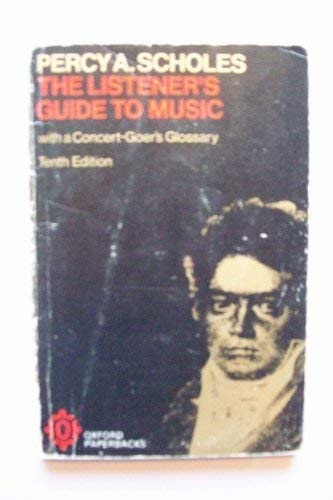
The Listener's Guide to Music: With a Concert-Goer's Glossary
0
0
As an Amazon Associate and affiliate partner, Menrva Books earns from qualifying purchases. Learn more
Author Description
The Listener’s Guide is dedicated ‘to the concert-goer, gramophonist, and radio listener’. With his vast knowledge Scholes shows how composers use their tools and deal with their material. He explains the various forms (sonata and symphony, fugue and oratorio, for example), the instruments of the orchestra, and the historical development of the composers. First published in 1919, this edition contains several minor corrections and additions and includes brief notes on electronic music, serial composition, and musique concrète. Percy Alfred Scholes (1877 – 1958) was an English musician, journalist, and prolific author, whose best-known achievement was the Oxford Companion to Music, first published 1938. This work took six years to produce and consisted of over a million words (surpassing the length of the Bible). Scholes wrote virtually all the text himself, the only exceptions being the article on tonic sol-fa (with which he was dissatisfied) and the synopses of the plots of operas (which he regarded as too boring). Although the Companion was (and is) regarded as authoritative, the text of the first edition is enlivened by Scholes's own anecdotal and sometimes quirky style. In his writing here and elsewhere Scholes never believed in holding back his personal views in favor of a neutral point of view. He is credited with the description of harpsichord music as sounding like "a toasting fork on a birdcage"; and wrote that "Handel was the more elegant composer, but Bach was the more thorough". In the Companion itself some composers (Berg, Schoenberg and Webern, for example) were described in somewhat unsympathetic and dismissive terms. Similarly, his article on the composer John Henry Maunder states the composer’s "seemingly inexhaustible cantatas – ‘Penitence, Pardon and Peace’ and ‘From Olivet to Calvary’ – long enjoyed popularity and still aid the devotions of undemanding congregations in less sophisticated areas."
Menrva's Summary
THE THESIS
This work investigates the fundamental structures and historical contexts of Western classical music to provide the layperson with the tools necessary for informed listening. Percy A. Scholes, a prominent English musicologist and journalist, utilizes his extensive background in music education to demystify complex compositions. He presents a framework that bridges the gap between technical musical theory and the casual experience of the concert-goer, gramophonist, and radio listener.
THE SCOPE MAP
What You Will Find
- Explanations of musical forms including sonatas, symphonies, fugues, and oratorios
- Descriptions of orchestral instrumentation and their roles
- Historical development of major composers and their stylistic evolution
- Brief notes on 20th-century developments like electronic music and serial composition
Scope Limits
- Does not provide an exhaustive musicological analysis of every composer
- Excludes detailed technical scores or advanced harmonic theory
THE AUTHORITY PERSPECTIVE
Readers frequently note the accessible, anecdotal, and occasionally opinionated prose style that characterizes Scholes's writing. Experts recognize this text as a foundational, albeit historically situated, guide for those seeking to understand the mechanics of classical music performance.
Page Count:
97
Publication Date:
2005-01-01
Publisher:
Oxford University Press
ISBN-10:
0192840029
ISBN-13:
9780192840028
Music
Musical Form
Music theory
Reference
Music Appreciation
Music History
Community Tags
Similar Books
![Great ideas in music ([Great ideas series, no. 2])](https://storage.googleapis.com/menrva_img_storage/covers/9780080070728.jpg)