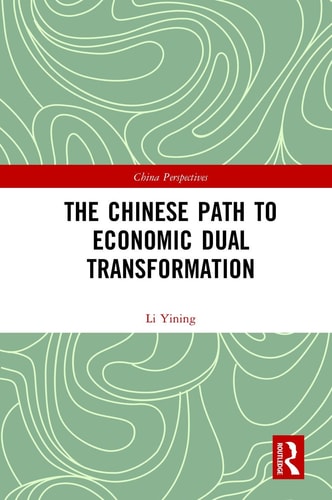
The Chinese Path to Economic Dual Transformation
0
0
As an Amazon Associate and affiliate partner, Menrva Books earns from qualifying purchases. Learn more
Author Description
Economic transformation in traditional development economics refers to the transition from an agricultural society to an industrial one. Based on the practical conditions and the experience since reform and opening up in the late 1970s, the author observes that the path China's economy takes is a dual transformation, namely, developmental transformation from an agricultural society to an industrial economy, and institutional transformation from planned economy to market economy. Centering on property ownership reform which is the supreme reform of the dual transformation, this book discusses land ownership approval, stock-holding system reform and the maintaining ownership of private enterprises, etc. Besides, the book expounds on the urbanization in China, believing that it is not only the outcome of the dual transformation but also the booster that will help China's economy continue to develop at a high speed. Independent innovation and industrial upgrading which is the key to the enhancement of enterprises' competitiveness is also covered. The combination or overlapping of the two types of transformations in China has had no precedent in history, and it has not been discussed in traditional development economics. Scholars and students in China's economic studies and development economics studies will be attracted by this book. In addition, this book will be a valuable reference for other developing countries which are undergoing economic transformation.
Menrva's Summary
THE THESIS
The book investigates China's unique economic transformation, characterized by a dual process of developmental and institutional change. The author, Yining Li, posits that China's economic path since the late 1970s involves not only a transition from an agricultural to an industrial society but also a shift from a planned to a market economy. The analysis centers on property ownership reform, including land and stock-holding systems, and the maintenance of private enterprises. Furthermore, the book examines urbanization as both a consequence and a driver of this dual transformation, alongside the critical role of independent innovation and industrial upgrading in enhancing competitiveness.
THE SCOPE MAP
- The dual transformation of China's economy: developmental (agricultural to industrial) and institutional (planned to market).
- In-depth analysis of property ownership reforms, including land and stock-holding systems.
- Discussion on the role of urbanization as an outcome and accelerator of economic growth.
- Exploration of independent innovation and industrial upgrading for enterprise competitiveness.
- Comparative perspective on traditional development economics and China's unique path.
- Valuable insights for developing countries undergoing economic transformation.
THE AUTHORITY PERSPECTIVE
The book is positioned as a significant contribution to the study of China's economic development, particularly for scholars and students in economics and development economics. Its focus on the unprecedented dual transformation offers a novel perspective beyond traditional economic models. The analysis of property rights, urbanization, and innovation is expected to provide valuable insights for both academic understanding and practical application in other developing nations.
Page Count:
276
Publication Date:
2018-01-01
Publisher:
Routledge
ISBN-10:
113880990X
ISBN-13:
9781138809901
Non-Fiction
Economics
China Studies
Economic History
Community Tags
Similar Books