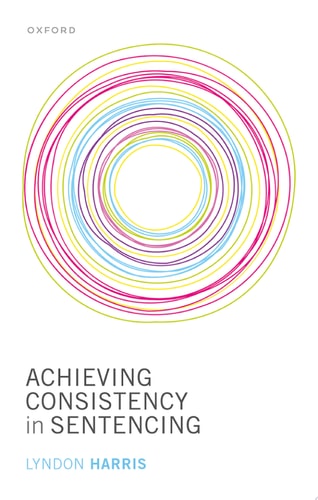
Achieving Consistency in Sentencing
0
0
As an Amazon Associate and affiliate partner, Menrva Books earns from qualifying purchases. Learn more
Author Description
The Sentencing Council of England and Wales has as its core aim to promote consistency in sentencing, with a developed system of appellate guidance at sentencing in addition to a narrative guidelines system which is now two decades old. As such, there is much to analyse and many lessons to be learned - for England and Wales and other jurisdictions. Consistency in sentencing is widely regarded to be an essential component of a fair sentencing system; but what does consistency mean exactly?In Achieving Consistency in Sentencing, the author maintains that consistency incorporates both substantive and procedural elements, focussing upon the proper application of principle. The notion of comparing 'like' cases is rejected as simplistic, impractical, and unprincipled. Lyndon Harris argues that a more principled approach reconciles the tension between consistency and individualised justice which has been suggested to exist. The author uses clear empirical evidence of inconsistency in sentencing to emphasize the crucial need for discretion during the sentencing exercise which, he argues, should be structured in a way that encourages sentences to be imposed in accordance with the principles underpinning the scheme while maintaining the ability to individualise sentences. Using England and Wales as a case study, this work analyses various methods of structuring discretion.The latter part of the book examines the interplay between the primary givers of guidance: Parliament, the Court of Appeal (Criminal Division), and the Sentencing Council and draws conclusions (good and bad) as to ways in which consistency can be achieved. Lyndon Harris identifies lessons to be learned while pointing out the strengths and deficiencies in the various devices used to guide sentencing judges when they are required to exercise their discretion. The book draws attention to the need for greater flexibility and structure while emphasising the work that needs to be done to address racial and gender
Menrva's Summary
THE THESIS
How can a legal system effectively balance the requirement for consistent sentencing with the necessity of individualized justice? Lyndon Harris, a legal expert, examines the two-decade-old sentencing guidelines system in England and Wales to determine how judicial discretion can be structured without sacrificing fairness. He argues that consistency should not be defined by the simplistic comparison of similar cases, but rather through the rigorous application of legal principles that allow for nuanced, individual outcomes.
THE SCOPE MAP
What You Will Find
- Analysis of the Sentencing Council of England and Wales guidelines
- Evaluation of the roles of Parliament and the Court of Appeal in providing sentencing guidance
- Empirical evidence regarding sentencing inconsistencies
- Theoretical frameworks for balancing discretion and structure
Scope Limits
- The book focuses primarily on the jurisdiction of England and Wales
- It does not provide a comprehensive global survey of all international sentencing models
THE AUTHORITY PERSPECTIVE
Legal scholars and practitioners view this work as a critical examination of the mechanics of judicial discretion within the English legal system. The text is noted for its analytical rigor and its practical focus on the interplay between legislative guidance and judicial application.
Page Count:
352
Publication Date:
2022-12-20
Publisher:
Oxford University Press
ISBN-10:
0192859269
ISBN-13:
9780192859266
Professional Career & Trade
Criminal Law
Law
Sentencing
Public Policy
Legal Theory
Community Tags
Similar Books