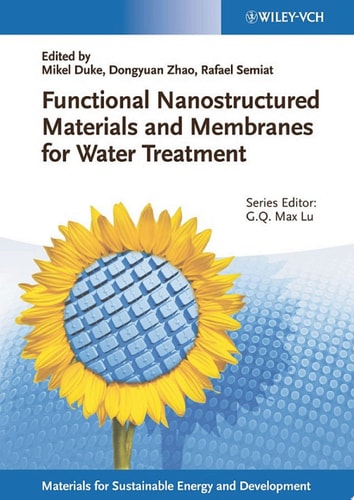
Functional Nanostructured Materials and Membranes for Water Treatment
0
0
As an Amazon Associate and affiliate partner, Menrva Books earns from qualifying purchases. Learn more
Author Description
Membranes have emerged over the last 30 years as a viable water treatment technology. Earth's population is growing and the need for alternative ways to generate potable water is rising. The recent advent of nanotechnology opens the door to improving processes in membrane technology, which is a promising step on the way to solving the earth's potable water problem. Current performance is enhanced and new concepts are possible by engineering on the nanoscale. This book presents key areas of nanotechnology such as fouling tolerant and robust membranes, enhanced destruction of pollutants and faster monitoring of water quality. 'Functional Nanostructured Materials and Membranes for Water Treatment' is part of the series on Materials for Sustainable Energy and Development edited by Prof. G.Q. Max Lu. The series covers advances in materials science and innovation for renewable energy, clean use of fossil energy, and greenhouse gas mitigation and associated environmental technologies.
Menrva's Summary
THE THESIS
The growing global demand for potable water necessitates advancements in water treatment technologies, with nanotechnology offering novel solutions for membrane-based systems. This book explores how engineering materials at the nanoscale can enhance membrane performance, leading to more effective pollutant destruction and faster water quality monitoring. It details key areas of functional nanostructured materials and membranes designed to address challenges like fouling and to improve overall water purification processes. The work is situated within the context of sustainable energy and development, focusing on materials innovation for environmental solutions.
THE SCOPE MAP
- Introduction to membrane technology as a viable water treatment solution.
- The role of nanotechnology in enhancing membrane performance.
- Development of fouling-tolerant and robust membranes.
- Methods for enhanced destruction of pollutants using nanostructured materials.
- Techniques for faster monitoring of water quality.
- Applications of functional nanostructured materials in water purification.
- Integration of nanotechnology with existing membrane processes.
- Future prospects and challenges in nanostructured membranes for water treatment.
THE AUTHORITY PERSPECTIVE
This book is presented as part of the Materials for Sustainable Energy and Development series, indicating its focus on cutting-edge materials science for environmental applications. The content is structured to cover key advancements in nanotechnology relevant to water treatment, suggesting a technical and research-oriented audience. It aims to bridge the gap between fundamental nanotechnology principles and practical membrane engineering for solving global water scarcity issues. The emphasis on fouling tolerance and pollutant destruction points to a focus on improving the efficiency and longevity of water purification systems.
Page Count:
318
Publication Date:
2013-03-14
Publisher:
Wiley
ISBN-10:
3527668489
ISBN-13:
9783527668489
Science
Non-Fiction
Nanotechnology
Water Treatment
Community Tags
Similar Books