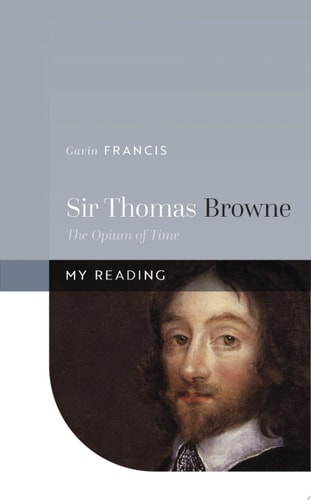
Sir Thomas Browne: The Opium of Time
0
0
As an Amazon Associate and affiliate partner, Menrva Books earns from qualifying purchases. Learn more
Author Description
In this book, Gavin Francis writes about the resonance for him as a medic in reading the work of early modern polymath Sir Thomas Browne.Sir Thomas Browne (1605-1682) was an English physician, wordsmith, and polymath who contributed hundreds of words to the English language (such as medical, electricity, migrant, and computer). After studying medicine in Montpellier, Padua, and Leiden, he settled in Norwich, where he practised as a doctor and wrote some of the greatest books of the seventeenth century, still read for their accessibility and eloquence.In Sir Thomas Browne: The Opium of Time, Dr Gavin Francis examines Browne's work through a variety of themes: ambiguity, curiosity, vitality, piety, humility, misogyny, mobility, and mortality. He argues that the work has lost little of its power and wisdom, and none of its beauty. Religio Medici ('Religion of the Doctor') examined the vexed question of faith in a God who, to a physician, seemed indifferent to suffering. Pseudodoxia Epidemica ('Vulgar Errors') gave free rein to an agile curiosity and sought to debunk notions then commonly believed, such as that dead kingfishers indicate the direction of the wind, or that a woman could get pregnant from sharing a bath with a man. Urne Buriall was Browne's meditation on mortality, occasioned by a find of funerary urns, while Museum Clausum ('Hidden Museum') sets out a series of thought experiments and counterfactuals, such as how history might have been different had Alexander the Great marched west instead of east.Gavin Francis draws on his own experiences as a twenty-first century writer and doctor to discover that although many centuries separate him from Browne, they share a fundamental curiosity about the world and about people.
Menrva's Summary
THE THESIS
This book investigates the enduring intellectual and professional resonance of seventeenth-century polymath Sir Thomas Browne for a modern-day medical practitioner. Gavin Francis, a physician and writer, utilizes his own clinical background to bridge the centuries between his practice and Browne’s, arguing that the physician’s perspective on mortality, curiosity, and faith remains profoundly relevant. By examining Browne’s major texts, Francis constructs a framework that highlights the intersection of scientific inquiry and humanistic reflection.
THE SCOPE MAP
What You Will Find
- Analysis of Browne’s major works including Religio Medici, Pseudodoxia Epidemica, and Urne Buriall.
- Exploration of thematic pillars such as ambiguity, piety, mortality, and intellectual curiosity.
- Integration of twenty-first-century medical experiences with early modern philosophical inquiry.
Scope Limits
- The text does not provide a comprehensive chronological biography of Browne’s entire life.
- It does not offer a technical medical history of the seventeenth century, focusing instead on the literary and philosophical output of the subject.
THE AUTHORITY PERSPECTIVE
Critics and readers frequently note the accessible and lyrical quality of Francis’s prose, which mirrors the eloquence of his subject. Experts highlight this work as a bridge between the humanities and medicine, suitable for both general readers and those interested in the history of ideas.
Page Count:
176
Publication Date:
2023-08-25
Publisher:
Oxford University Press
ISBN-10:
0192858173
ISBN-13:
9780192858177
Non-Fiction
Biography
Essays
Renaissance
Literary Criticism
MEDICAL History
Medicine history
Community Tags
Similar Books