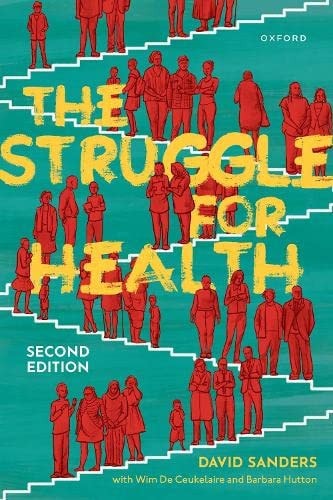
The Struggle for Health: Medicine and the Politics of Underdevelopment
0
0
As an Amazon Associate and affiliate partner, Menrva Books earns from qualifying purchases. Learn more
Author Description
The first edition of The Struggle for Health was published in 1985 and was widely acclaimed by those seeking a broader and deeper political understanding of ill health, beyond the medical model of care. It was a revolutionary book, charting new ways of understanding and tackling the causes of ill health, and suggesting strategies to enable health for all.This second edition includes health problems that have emerged since the 1980s, notably HIV/AIDs, COVID-19, and other epidemics, and the increase in non-communicable diseases, such as cardiovascular disease and diabetes. It examines some of the health impacts of globalization, specifically on the food and pharmaceutical value chains, and considers the consequences of climate change on the health of populations. However, this edition does not depart from the core message of the original book: Health for All can only be achieved through a more equitable distribution of wealth, resources, and power.The Struggle for Health, Second Edition, utilises the same approach as the first, with a narrative that begins with diseases, then describes historical trends and the limitation of the medical (and commercial) model of care. At each juncture, it asks the question 'WHY' - why do people, especially children, still die in large numbers throughout the world, from wholly preventable diseases? Why is it that appropriate provision for health care is not available to every individual in the world? What changes can be made to improve this situation? Most importantly, this edition presents a strengthened call to action, building upon the original work and advocating for systemic changes to ensure justice and equity in health for all.
Menrva's Summary
THE THESIS
This work investigates why preventable diseases and health inequities persist globally despite advancements in medical technology. The authors, Barbara Hutton, David H. Sanders, and Wim De Ceukelaire, utilize a political-economic framework to argue that health outcomes are fundamentally tied to the distribution of wealth, resources, and power. By critiquing the limitations of the traditional medical model, they propose that systemic socio-political change is the only viable path to achieving universal health equity.
THE SCOPE MAP
What You Will Find
- Analysis of health impacts resulting from globalization and pharmaceutical value chains
- Examination of modern health crises including HIV/AIDS, COVID-19, and non-communicable diseases
- Historical trends in global health policy and the failure of commercialized care models
- Strategies for systemic reform to address health disparities
Scope Limits
- The text does not provide clinical medical guidance or individual treatment protocols
- It focuses primarily on macro-level political and economic structures rather than localized hospital management
THE AUTHORITY PERSPECTIVE
Experts recognize this text as a foundational critique of the medical model, frequently citing its utility in public health education and political advocacy. Readers often note the density of the prose, which balances historical analysis with a clear, urgent call for structural reform.
Page Count:
352
Publication Date:
2023-06-23
Publisher:
Oxford University Press
ISBN-10:
0192858459
ISBN-13:
9780192858450
Public Health
Medicine
Social justice
Sociology
Globalization
Community Tags
Similar Books