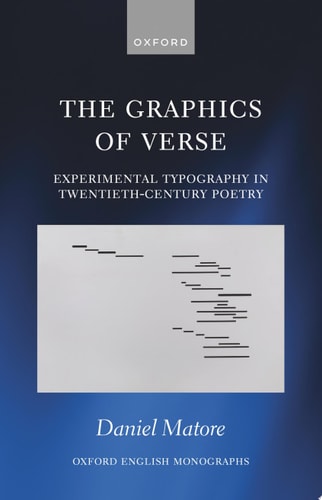
The Graphics of Verse: Experimental Typography in Twentieth-Century Poetry
0
0
As an Amazon Associate and affiliate partner, Menrva Books earns from qualifying purchases. Learn more
Author Description
Is poetry a visual art? Why do the pages of nineteenth-century poetry look so different to those of twentieth-century verse? Exploiting the expressive possibilities of print--from spacing and indentation to alignment and typeface--is one of the defining ways in which poetry was modernized in the twentieth century. While the visual experiments of European poets have been well documented, the typographical explorations of poets writing in English have been largely neglected. This volume confronts a major unanswered question: why did British and American poets, from the beginning of the twentieth century right up to the present day, choose to experiment with the design and lay-out of the printed page?This book aims to provide the first detailed account of this lineage of literary style, examining the poetry and criticism of figures such as Ezra Pound, Hope Mirrlees, William Carlos Williams, E.E. Cummings, Marianne Moore, David Jones, Denise Levertov, Charles Olson, Frances Motz Boldereff, and J.H. Prynne. It draws on unpublished archival materials to show how poets began to draft, sketch, and compose in new and eccentric ways as they annexed the roles of book designer and printer. Typography, it argues, was instrumental in debates about metre, free verse, and the nature of poetry as poems morphed into scores, slogans, maps, and signs. It investigates how the typography of poetry was animated by musicology, psychophysics, linguistics, politics, ophthalmology, cartography, and advertising.
Menrva's Summary
THE THESIS
This volume investigates the historical and aesthetic motivations behind the shift toward experimental typography in twentieth-century British and American poetry. Daniel Matore, drawing on extensive archival research, argues that the visual arrangement of text became a primary site for poetic innovation, allowing poets to function as their own designers and printers. By analyzing the intersection of print culture and literary theory, the author demonstrates how typographical choices were central to the evolution of free verse and the broader modernization of poetic form.
THE SCOPE MAP
What You Will Find
- Analysis of works by Ezra Pound, E.E. Cummings, Marianne Moore, and J.H. Prynne.
- Examination of the influence of musicology, cartography, and advertising on poetic layout.
- Use of unpublished archival materials, including drafts and sketches.
Scope Limits
- The study focuses primarily on British and American poets, excluding a comprehensive analysis of European avant-garde movements.
- The text does not provide a technical manual for typography but focuses on the literary implications of design.
THE AUTHORITY PERSPECTIVE
Scholars recognize this work as a significant contribution to the study of material modernism and the visual history of the printed page. Experts highlight the text for its meticulous archival research and its ability to bridge the gap between literary criticism and graphic design history.
Page Count:
256
Publication Date:
2024-01-01
Publisher:
Oxford University Press
ISBN-10:
0192857215
ISBN-13:
9780192857217
Poetry
Literary History
Poetry
Typography
Graphic Design
Literary Criticism
Modernism
Community Tags
Similar Books