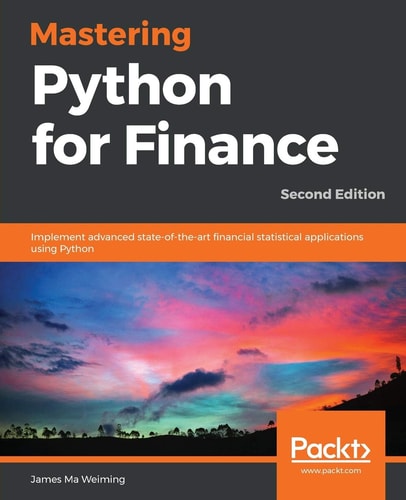
Mastering Python for Finance: Implement Advanced State-Of-the-art Financial Statistical Applications Using Python, 2nd Edition
0
0
As an Amazon Associate and affiliate partner, Menrva Books earns from qualifying purchases. Learn more
Author Description
Take your financial skills to the next level by mastering cutting-edge mathematical and statistical financial applications Key Features: Explore advanced financial models used by the industry and ways of solving them using Python Build state-of-the-art infrastructure for modeling, visualization, trading, and more Empower your financial applications by applying machine learning and deep learning Book Description: The second edition of Mastering Python for Finance will guide you through carrying out complex financial calculations practiced in the industry of finance by using next-generation methodologies. You will master the Python ecosystem by leveraging publicly available tools to successfully perform research studies and modeling, and learn to manage risks with the help of advanced examples. You will start by setting up your Jupyter notebook to implement the tasks throughout the book. You will learn to make efficient and powerful data-driven financial decisions using popular libraries such as TensorFlow, Keras, Numpy, SciPy, and scikit-learn. You will also learn how to build financial applications by mastering concepts such as stocks, options, interest rates and their derivatives, and risk analytics using computational methods. With these foundations, you will learn to apply statistical analysis to time series data, and understand how time series data is useful for implementing an event-driven backtesting system and for working with high-frequency data in building an algorithmic trading platform. Finally, you will explore machine learning and deep learning techniques that are applied in finance. By the end of this book, you will be able to apply Python to different paradigms in the financial industry and perform efficient data analysis. What You Will Learn: Solve linear and nonlinear models representing various financial prob
Menrva's Summary
THE THESIS
This book equips readers with advanced Python techniques to implement state-of-the-art financial statistical applications. The second edition guides users through complex financial calculations using next-generation methodologies and the Python ecosystem. It covers setting up Jupyter notebooks, leveraging libraries like TensorFlow, Keras, Numpy, SciPy, and scikit-learn for data-driven decisions, and building financial applications related to stocks, options, interest rates, and risk analytics. The book also explores statistical analysis of time series data for backtesting and algorithmic trading, culminating in an exploration of machine learning and deep learning in finance.
THE SCOPE MAP
- Setting up a Jupyter notebook environment for financial analysis.
- Implementing advanced financial models using Python libraries.
- Managing risks with practical, data-driven examples.
- Building financial applications for stocks, options, interest rates, and derivatives.
- Applying computational methods for risk analytics.
- Performing statistical analysis on time series data.
- Developing an event-driven backtesting system.
- Building an algorithmic trading platform with high-frequency data.
- Exploring machine learning and deep learning techniques in finance.
THE AUTHORITY PERSPECTIVE
This book is designed for finance professionals and developers seeking to enhance their quantitative skills with Python. The content focuses on practical implementation of advanced financial models and applications, suggesting a technical and in-depth approach. It aims to empower readers to make data-driven decisions and build sophisticated financial tools, indicating a target audience comfortable with programming and statistical concepts. The inclusion of machine learning and deep learning further positions it as a resource for those interested in cutting-edge financial technology.
Page Count:
426
Publication Date:
2019-01-01
Publisher:
Packt Publishing
ISBN-10:
1789346460
ISBN-13:
9781789346466
Science & Technology
Non-Fiction
Data Science
Python
Finance
Machine Learning
Community Tags
Similar Books