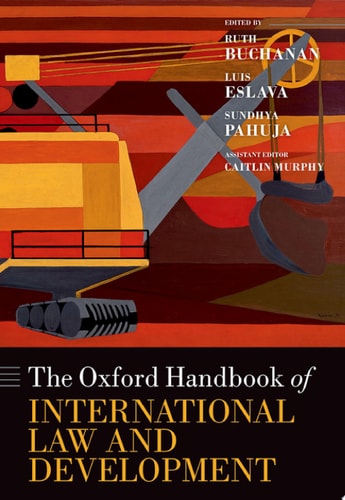
The Oxford Handbook of International Law and Development
0
0
As an Amazon Associate and affiliate partner, Menrva Books earns from qualifying purchases. Learn more
Author Description
Since the mid-twentieth century, 'international law' and 'international development' have become two of the most prominent secular languages through which aspirations about a better world are articulated.. They have shaped the both the treatment and self-understanding of the 'developing' world, often by positing the West as a universal model against which developing states, their citizens, and natural environments should be measured and disciplined. In recent years, however, critical scholars have investigated the deep linkages between the concept of development, the doctrines and institutions of international law, and broader projects of ordering at the international level. They have shown how the leading models de-radicalise, if not derail, initiatives to redefine development and pursue other forms of global well-being.Bringing together scholars from both the Global South and the Global North, the contributions in this Handbook invite readers to consider the limits of common normative and developmentalist assumptions. At the same time, the Handbook demonstrates how disparate but still identifiable set of ideas, imaginaries, norms, and institutional practices - related to law, development and international governance - shape today's profoundly unequal material conditions, threatening the future of human and nonhuman life on the planet. The book focuses on five distinct areas: existing disciplinary frameworks, institutions and actors, regional theatres of international law and development, competing social and economic agendas, and alternative futures.Offering a unique overview of the field of international law and development and assembling major critical, historical, and political economic insights, this Handbook is an unmissable resource for scholars of international law, international relations, development studies, and global history, as well as anyone interested in the past, present, and future of our world.
Menrva's Summary
THE THESIS
This volume investigates the complex, often problematic relationship between international law and international development, questioning how these frameworks have historically shaped global inequality and the governance of the developing world. The editors, Ruth Buchanan, Luis Eslava, and Sundhya Pahuja, curate a collection of essays from a diverse group of international scholars. The text challenges traditional developmentalist assumptions by examining how legal doctrines and institutional practices have functioned to maintain Western-centric models of progress while often undermining alternative visions of global well-being.
THE SCOPE MAP
What You Will Find
- Analysis of disciplinary frameworks and institutional actors in international law.
- Regional case studies examining the application of development norms.
- Critical inquiries into competing social and economic agendas.
- Explorations of alternative futures for global governance.
Scope Limits
- The text focuses primarily on critical, historical, and political economic perspectives rather than providing a technical manual for legal practitioners.
- It does not offer a singular, unified theory of development but rather presents a plurality of scholarly viewpoints.
THE AUTHORITY PERSPECTIVE
Experts identify this handbook as a comprehensive resource for academics and students in law, international relations, and development studies. Readers frequently note the academic density of the prose, which provides a rigorous examination of the structural inequalities inherent in contemporary international governance.
Page Count:
864
Publication Date:
2024-01-01
Publisher:
Oxford University Press
ISBN-10:
0192867369
ISBN-13:
9780192867360
Law and Governance
International relations
Global History
International Law
Community Tags
Similar Books


Reader Comments
Share Your Thoughts
No comments yet. Be the first to share your thoughts!