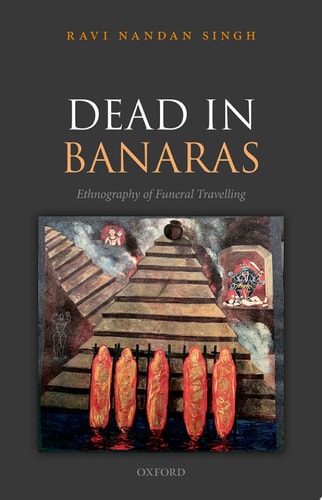
Dead in Banaras: An Ethnography of Funeral Travelling
0
0
As an Amazon Associate and affiliate partner, Menrva Books earns from qualifying purchases. Learn more
Author Description
Ethnographies fatefully rely on chance encounters and mysteriously so such encounters come true. "Dead in Banaras" is an instance of just such a fateful chance encounter. In its inception, it set out to follow the 'dead' across multiple social locations of crematoria, hospital, morgue and the aghorashram, in order to assemble a contemporary moment in the funerary iconicity of the well known North Indian city of Banaras. The crematoria in plural because the open-air manual pyres and closed-door electric furnaces sit side by side within the symbolic inside of the city. The hospital and morgue became chosen destinations because in the local moral world, the city is a medical metropolis anchored by a famed university hospital and storied through real life dramatic narratives of medical emergency, saving and untimely death. Aghorashram on the other hand as an urban Shaivite clinic and hermitage for sexual and reproductive cures works with funerary substances as pharmacopeia. Early on, while undertaking fieldwork, these funerary journeys of the' dead' had a chance encounter with the author's father's death in the city. The same set of places, thereafter, spoke through the sensory logic of the author's father's death. Dead in Banaras is, thus, both an ethnography of being in the dead centre of a city and an autobiographical funeral travelling (Shav Yatra) that narrates the city through a mourner's logic of using the pyre to illuminate the dead as a multiplicity.
Menrva's Summary
THE THESIS
This work investigates the intersection of funerary practices, urban identity, and personal grief within the city of Banaras. The author, an anthropologist, utilizes his own experience of his father's death to frame a broader ethnographic study of the city's relationship with mortality. By examining sites such as crematoria, hospitals, and the Aghorashram, the text argues that the city's identity is constructed through the constant presence and management of the dead.
THE SCOPE MAP
What You Will Find
- Analysis of funerary infrastructure including electric furnaces and open-air pyres
- Examination of the medical metropolis and its role in local moral narratives
- Exploration of the Aghorashram as a site where funerary substances are utilized for healing
- Integration of autobiographical narrative with formal ethnographic observation
Scope Limits
- The study is geographically confined to the city of Banaras and its specific funerary institutions
- It does not provide a comprehensive survey of all Hindu funerary rites across India
THE AUTHORITY PERSPECTIVE
Scholars in the field of anthropology recognize this text for its unique synthesis of personal mourning and academic inquiry. Readers frequently note the dense, reflective nature of the prose as it navigates the complex cultural landscape of death in an urban Indian context.
Page Count:
184
Publication Date:
2023-01-01
Publisher:
Oxford University Press
ISBN-10:
0192864289
ISBN-13:
9780192864284
Ethnography
Death Studies
India
Sociology
Anthropology
Community Tags
Similar Books