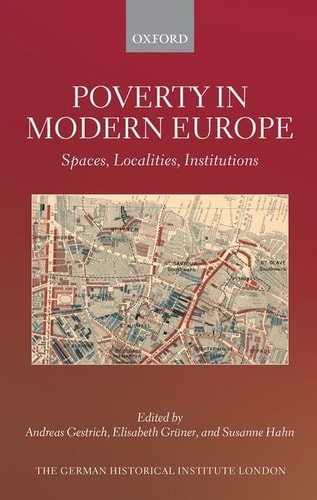
Poverty in Modern Europe: Spaces, Localities, Institutions
0
0
As an Amazon Associate and affiliate partner, Menrva Books earns from qualifying purchases. Learn more
Author Description
Poverty in Modern Europe explores the spatial dimensions of poverty in nineteenth and twentieth-century Europe. Its essays focus on a variety of regional, local, and institutional settings and apply different approaches and methods, such as micro history, historical geography, network analysis, and the study of political and academic expert discourses. They are grouped into four sections. The first concentrates on the question of how it was that within the same national legal framework, poverty could be administered and experienced so differently at regional and local levels. Although the discussion of 'welfare regionalism' has been accepted as an important perspective in both the social sciences and social history, it has not resulted in many comparative studies or produced a valid framework for comparisons. The following three sections ask how urban and rural spaces of poverty were constructed by political, academic, and administrative discourses and how 'localities' of poor relief were experienced by the poor. Many essays look into the spatial dimensions of processes of inclusion and exclusion. They examine the role played by institutions (such as workhouses) and by social networks (such as families and neighbourhoods), and are particularly interested in what has frequently, albeit not uncontroversially, been termed the 'agency' of the poor and its spatial dimensions. The volume tests different approaches in different countries and suggests a number of aspects and yardsticks to consider when comparing regional or local differences. While the main geographical focus is on English-speaking and German-speaking Europe, the volume also contains comparative perspectives on France and Russia.
Menrva's Summary
THE THESIS
This volume investigates how the spatial dimensions of poverty in nineteenth and twentieth-century Europe influenced the administration, experience, and construction of social welfare. The editors, Andreas Gestrich, Elisabeth Grüner, and Susanne Hahn, compile a series of essays that utilize diverse methodologies—including microhistory, historical geography, and network analysis—to examine how national legal frameworks manifested differently across various regional and local settings. By analyzing political, academic, and administrative discourses, the contributors argue that poverty is not a uniform experience but one shaped by specific institutional and geographical contexts.
THE SCOPE MAP
What You Will Find
- Comparative analysis of welfare regionalism across English-speaking, German-speaking, French, and Russian contexts.
- Methodological applications of microhistory, historical geography, and network analysis to social welfare data.
- Examination of institutional spaces such as workhouses and the role of social networks like families and neighborhoods.
Scope Limits
- The volume does not provide a comprehensive history of European poverty but focuses specifically on spatial and institutional variations.
- It does not offer a singular, unified theory of poverty, instead testing multiple comparative approaches.
THE AUTHORITY PERSPECTIVE
Scholars and historians recognize this work as a significant contribution to the study of welfare regionalism and the spatial history of social policy. Readers frequently note the academic density of the prose and the specialized nature of the comparative methodologies employed throughout the essays.
Page Count:
375
Publication Date:
2022-12-19
Publisher:
Oxford University Press
ISBN-10:
0192867849
ISBN-13:
9780192867841
History
Sociology
European History
Academic
Europe
Social History
Community Tags
Similar Books