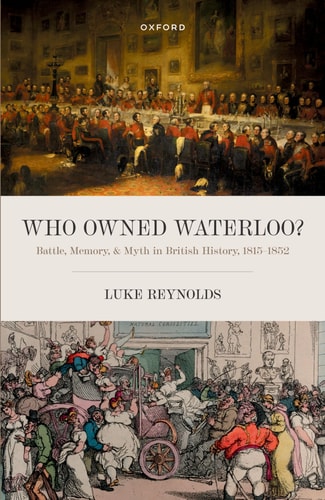
Who Owned Waterloo?: Battle, Memory, and Myth in British History, 1815-1852
0
0
As an Amazon Associate and affiliate partner, Menrva Books earns from qualifying purchases. Learn more
Author Description
Between 1815 and the Duke of Wellington's death in 1852, the Battle of Waterloo became much more than simply a military victory. While other countries marked the battle and its anniversary, only Britain actively incorporated the victory into their national identity, guaranteeing that it would become a ubiquitous and multi-layered presence in British culture. By examining various forms of commemoration, celebration, and recreation, Who Owned Waterloo? demonstrates that Waterloo's significance to Britain's national psyche resulted in a different kind of war altogether: one in which civilian and military groups fought over and established their own claims on different aspects of the battle and its remembrance. By weaponizing everything from memoirs, monuments, rituals, and relics to hippodramas, panoramas, and even shades of blue, veterans pushed back against civilian claims of ownership; English, Scottish, and Irish interests staked their claims; and conservatives and radicals duelled over the direction of the country. Even as ownership was contested among certain groups, large portions of the British population purchased souvenirs, flocked to spectacles and exhibitions, visited the battlefield itself, and engaged in a startling variety of forms of performative patriotism, guaranteeing not only the further nationalization of Waterloo, but its permanent place in nineteenth century British popular and consumer culture.
Menrva's Summary
THE THESIS
This work investigates how the Battle of Waterloo was transformed from a military event into a contested symbol of British national identity between 1815 and 1852. Luke Reynolds, a historian specializing in nineteenth-century British culture, utilizes a wide array of primary sources—including memoirs, monuments, and popular media—to argue that the battle served as a focal point for internal political and social struggles. He demonstrates that various factions, ranging from veterans to political radicals, actively competed to define the meaning of the victory to suit their own ideological agendas.
THE SCOPE MAP
What You Will Find
- Analysis of commemorative practices including monuments, rituals, and relics.
- Examination of popular culture representations such as hippodramas, panoramas, and consumer souvenirs.
- Investigation of regional and political tensions between English, Scottish, and Irish interests.
- Study of the conflict between military veterans and civilian populations regarding historical ownership.
Scope Limits
- The analysis is strictly bounded by the years 1815 to 1852, ending with the death of the Duke of Wellington.
- The text focuses primarily on British domestic reception rather than international or continental European perspectives.
THE AUTHORITY PERSPECTIVE
Historians and scholars of nineteenth-century studies note the meticulous archival research Reynolds employs to map the intersection of military history and public memory. Experts highlight this as a significant contribution to understanding how national myths are constructed and contested through consumer culture and performative patriotism.
Page Count:
272
Publication Date:
2024-01-01
Publisher:
Oxford University Press
ISBN-10:
0192865285
ISBN-13:
9780192865281
History
Cultural History
Nineteenth century
Europe
New Used & Rental Textbooks
Military History
Educational Resources
British History
Memory Studies
Community Tags
Similar Books