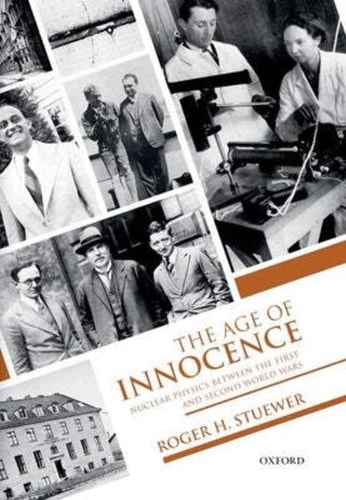
The Age of Innocence: Nuclear Physics between the First and Second World Wars
0
0
As an Amazon Associate and affiliate partner, Menrva Books earns from qualifying purchases. Learn more
Author Description
Highly Recommended CHOICEA fascinating account of the experimental innovations and theoretical breakthroughs in nuclear physics in the period between the two world wars told through the lives and personalities of the physicists who made them.The two decades between the first and second world wars saw the emergence of nuclear physics as the dominant field of experimental and theoretical physics, owing to the work of an international cast of gifted physicists. Prominent among them were Ernest Rutherford, George Gamow, the husband and wife team of Frédéric and Irène Joliot-Curie, John Cockcroft and Ernest Walton, Gregory Breit and Eugene Wigner, Lise Meitner and Otto Robert Frisch, the brash Ernest Lawrence, the prodigious Enrico Fermi, and the incomparable Niels Bohr.Their experimental and theoretical work arose from a quest to understand nuclear phenomena; it was not motivated by a desire to find a practical application for nuclear energy. In this sense, these physicists lived in an 'Age of Innocence'. They did not, however, live in isolation. Their research reflected their idiosyncratic personalities; it was shaped by the physical and intellectual environments of the countries and institutions in which they worked. It was also buffeted by the political upheavals after the Great War: the punitive postwar treaties, the runaway inflation in Germany and Austria, the Great Depression, and the intellectual migration from Germany and later from Austria and Italy.Their pioneering experimental and theoretical achievements in the interwar period therefore are set within their personal, institutional, and political contexts. Both domains and their mutual influences are conveyed by quotations from autobiographies, biographies, recollections, interviews, correspondence, and other writings of physicists and historians.
Menrva's Summary
THE THESIS
This book investigates how the foundational breakthroughs in nuclear physics between the First and Second World Wars were shaped by the personal, institutional, and political contexts of the scientists involved. Roger H. Stuewer, a historian of science, utilizes a vast array of primary sources—including correspondence, autobiographies, and interviews—to reconstruct the intellectual environment of the era. He argues that the rapid development of nuclear theory and experimentation was driven by pure scientific curiosity rather than the later pursuit of nuclear energy applications, characterizing this period as an 'Age of Innocence.'
THE SCOPE MAP
What You Will Find
- Detailed accounts of experimental innovations by figures such as Ernest Rutherford, Enrico Fermi, and Niels Bohr.
- Analysis of how political upheavals, including the Great Depression and the rise of fascism, influenced scientific migration and research.
- Examination of the institutional environments in Germany, Austria, Italy, and beyond.
Scope Limits
- The text does not focus on the subsequent development of nuclear weaponry or the Manhattan Project.
- It does not provide a technical manual for nuclear physics calculations or advanced mathematical derivations.
THE AUTHORITY PERSPECTIVE
Experts and reviewers recognize this work as a comprehensive historical account that successfully bridges the gap between technical scientific progress and the human experience of the researchers. Readers frequently note the academic density of the prose, which provides a rigorous look at the social and political forces that defined early 20th-century physics.
Page Count:
512
Publication Date:
2022-07-29
Publisher:
Oxford University Press
ISBN-10:
0192865552
ISBN-13:
9780192865557
History
Biography
Earth Sciences
Physics
Science History
Nuclear Physics
20th Century
Community Tags
Similar Books