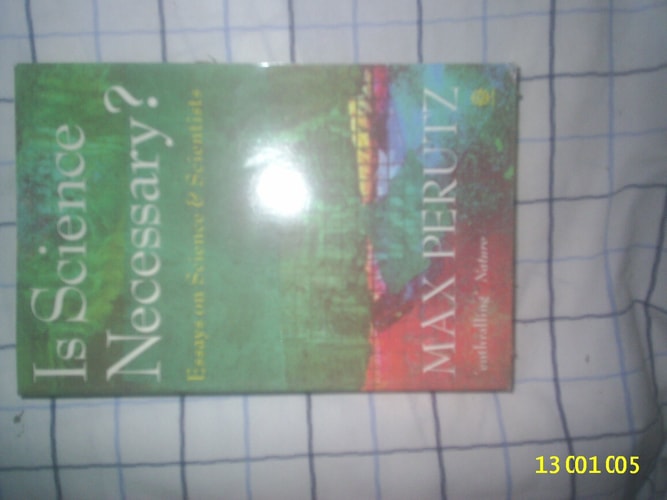
Is Science Necessary?: Essays on Science and Scientists
0
0
As an Amazon Associate and affiliate partner, Menrva Books earns from qualifying purchases. Learn more
Author Description
The double-edged sword modern science wields has excited controversy for years, and there is no end to the debate in sight. The genetic engineering that may one day cure cancer could also deprive the human race of its very individuality. Chemicals like DDT, which have increased food production the world over--saving millions from starvation--have also seriously polluted our environment. And most notoriously, the nuclear technology that provides us with cheap and efficient energy also fuels the horrifying weaponry of Armageddon. Such contradictions have prompted Nobel Prize-winning scientist Max F. Perutz to ask quite simply "Is science necessary?"Throughout this provocative collection of essays--a unique blend of history, criticism, philosophy, and memoir--Perutz answers his question with a resounding "yes." Ranging from the title piece, where he examines the crucial role science has played in every aspect of modern life, to striking portraits of such great scientists as Alexander Fleming, Ernest Rutherford, Max Planck, and Chaim Weizmann, Perutz's essays demonstrate how "the survival of nature and of civilization" depends upon an intelligent and scrupulous application of science, and an understanding--by all of us--of its basic ways and means.Some of the most compelling essays are of a personal nature. "Enemy Alien" tells the troubling story of Perutz's deportation from England as a German national during the Second World War. He provides fascinating insights into the secret military projects he worked on after the war, the most interesting of which a futuristic attempt to convert icebergs into aircraft carriers. And throughout Perutz writes of the excitement of discovery--whether of a revolutionary new medicine like penicillin or of theories such as quantum physics that forever changed the way we look at the world.Far from being "a soulless hermit toiling away at abstruse problems that he cannot explain except in incomprehensible gibberish," the scientist, as Perutz shows, is a person of passion and social conscience.
Menrva's Summary
THE THESIS
This collection of essays investigates whether the benefits of modern scientific advancement outweigh the inherent risks and ethical contradictions posed by technological progress. Max F. Perutz, a Nobel Prize-winning molecular biologist, utilizes his extensive career and personal history to argue that science remains a vital component for the survival of civilization. He presents a framework that balances historical analysis, philosophical inquiry, and personal memoir to demonstrate how scientific application requires both intellectual rigor and moral responsibility. By examining the lives of prominent figures and his own experiences, Perutz asserts that the public must engage with the methods and implications of scientific discovery.
THE SCOPE MAP
What You Will Find
- Historical analysis of major scientific breakthroughs including penicillin and quantum physics.
- Biographical portraits of influential scientists such as Alexander Fleming, Ernest Rutherford, and Max Planck.
- Personal accounts of the author's experiences as an 'enemy alien' during World War II and his involvement in secret military projects.
- Philosophical discussions regarding the environmental and ethical impact of genetic engineering and nuclear technology.
Scope Limits
- The text does not provide a comprehensive technical manual for the scientific fields discussed.
- It does not offer a definitive policy roadmap for future global scientific regulation.
THE AUTHORITY PERSPECTIVE
Critics and readers frequently praise the collection for its accessible prose and the author's ability to humanize complex scientific figures. Experts highlight this work as a significant contribution to the public understanding of science, noting its successful blend of technical insight and personal reflection.
Page Count:
304
Publication Date:
1991-04-04
Publisher:
Oxford University Press
ISBN-10:
0192861182
ISBN-13:
9780192861184
Science
Biography
Memoir
Philosophy of
Science
Scientists
Essays
Science History
Community Tags
Similar Books