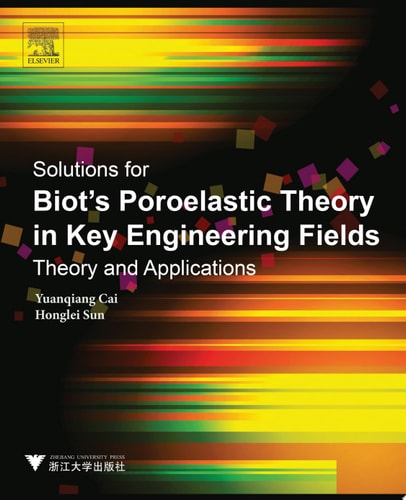
Solutions for Biot's Poroelastic Theory in Key Engineering Fields
0
0
As an Amazon Associate and affiliate partner, Menrva Books earns from qualifying purchases. Learn more
Author Description
Solutions for Biot's Poroelastic Theory in Key Engineering Fields: Theory and Applications provides solutions related to soil-structure interactions based on a poroelasticity theory, including moving loads such as trains. This book provides the commonly used methods for solving Biot’s formulations and conclusions on fully-saturated soil dynamics. It presents various solution methods used in Biot’s theory, such as the integral transformation method, the wave potential decomposition method, the finite element, and the 2.5D finite element method. It is suitable for graduate students, researchers and engineers who are interested in the soil-structure interaction problem with Biot’s theory, as well as engineers in several subdisciplines. Focuses on the structure-saturated soil interactions based on Biot’s theory Provides solutions (analytical and numerical) related to soil-structure interactions based on a poroelasticity theory, including moving loads such as trains Includes common and novel solution methods for Biot’s formulation
Menrva's Summary
THE THESIS
This book investigates the application of Biot's poroelastic theory to solve complex soil-structure interaction problems in key engineering fields. It presents a comprehensive overview of analytical and numerical methods for addressing Biot's formulations, focusing on scenarios involving moving loads like trains and fully-saturated soil dynamics. The authors detail various solution techniques, including integral transformation, wave potential decomposition, and finite element methods, providing practical insights for researchers and engineers.
THE SCOPE MAP
- Solutions for soil-structure interactions based on Biot's poroelasticity theory.
- Analysis of moving loads, specifically trains, on saturated soils.
- Commonly used and novel methods for solving Biot's formulations.
- Detailed explanations of integral transformation, wave potential decomposition, finite element, and 2.5D finite element methods.
- Conclusions on fully-saturated soil dynamics.
- Applications relevant to civil engineering and geotechnical fields.
THE AUTHORITY PERSPECTIVE
The book is structured to serve graduate students, researchers, and practicing engineers in the field of soil-structure interaction. Its focus on practical solution methods for Biot's theory suggests it is a valuable resource for those dealing with complex geomechanical problems. The inclusion of both established and advanced numerical techniques indicates a comprehensive approach to the subject matter.
Page Count:
186
Publication Date:
2017-05-09
Publisher:
Elsevier S & T
ISBN-10:
0128126507
ISBN-13:
9780128126509
Non-Fiction
Science
Engineering
Geotechnical Engineering
Civil Engineering
Numerical Methods
Applied Mechanics
Community Tags
Similar Books