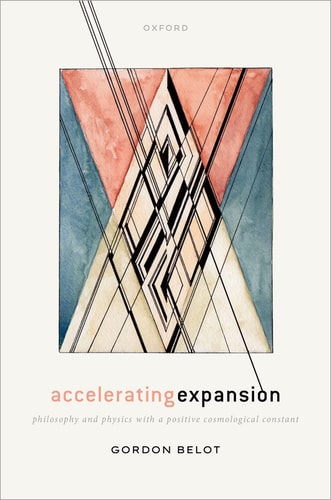
Accelerating Expansion: Philosophy and Physics with a Positive Cosmological Constant
0
0
As an Amazon Associate and affiliate partner, Menrva Books earns from qualifying purchases. Learn more
Author Description
Accelerating Expansion explores some of the philosophical implications of modern cosmology, focused on the significance that the discovery of the accelerating expansion of the Universe has for our understanding of time, geometry, and physics. The appearance of the cosmological constant in the equations of general relativity allows one to model universes in which space has an inherent tendency towards expansion. This constant, introduced by Einstein but subsequently abandoned by him, returned to centre stage with the discovery of the accelerating expansion. This pedagogically-oriented essay begins with a study of the most basic and elegant relativistic world that involves a positive cosmological constant, de Sitter spacetime. It then turns to the relatives of de Sitter spacetime that dominate modern relativistic cosmology. Some of the topics considered include: the nature of time and simultaneity in de Sitter worlds; the sense in which de Sitter spacetime is a powerful dynamical attractor; the limited extent to which observation can give us information about the topology of space in a world undergoing accelerated expansion; and cosmologists' favourite sceptical worry about the reliability of evidence and the possibility of knowledge, the problem of Boltzmann brains.
Menrva's Summary
THE THESIS
This work investigates the philosophical and physical implications of a positive cosmological constant within the framework of modern cosmology. Prof. Gordon Belot, a philosopher of physics, utilizes the mathematical structures of general relativity to examine how the accelerating expansion of the universe challenges traditional understandings of time, geometry, and scientific epistemology. The text provides a rigorous analysis of de Sitter spacetime and its dynamical properties to address foundational questions about the nature of the cosmos.
THE SCOPE MAP
What You Will Find
- Mathematical and conceptual analysis of de Sitter spacetime
- Examination of dynamical attractors in relativistic models
- Discussion of the Boltzmann brain problem in cosmology
- Exploration of limits on observational knowledge regarding spatial topology
Scope Limits
- The text does not provide a comprehensive history of all cosmological models
- It does not offer a complete unified theory of quantum gravity
THE AUTHORITY PERSPECTIVE
Experts identify this text as a valuable bridge between technical relativistic physics and the philosophy of science. Readers frequently note the academic density of the prose, which requires a foundational understanding of general relativity to fully grasp the arguments presented.
Page Count:
240
Publication Date:
2023-01-01
Publisher:
Oxford University Press
ISBN-10:
019286646X
ISBN-13:
9780192866462
Science
Philosophy
General Relativity
Physics
Cosmology
Community Tags
Similar Books