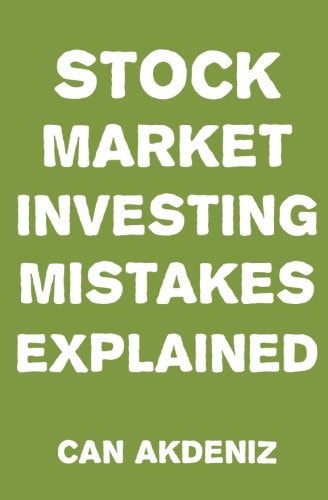
Stock Market Investing Mistakes Explained
0
0
As an Amazon Associate and affiliate partner, Menrva Books earns from qualifying purchases. Learn more
Author Description
Just as with raising children or as in nurturing one's career, "success" with personal investing allows plenty of room for subjectivity. After exploring the common opinion of prominent economic actors, established entrepreneurs and financial advisors, I have come to define a successful investor as someone who, with a moderate of time, devises an investment strategy to achieve financial and personal objectives and who gains access to competitive returns by undertaking a certain degree of financial risk. Upon a careful investigation of recent market trends, investing research and stock market perception, it becomes apparent that stock market-specific decision-making builds both on objective variables (unbiased reports, facts, financial figures, diagrams), and subjective factors, in other words, investors' reactions to quantifiable market indicators (apprehension, haste, stubbornness, fear, greed, impatience, etc.). Especially among the ranks of inexperienced stock market investors, this overlap renders market actors prone to a number of investing mistakes, some bigger than others. In other words, quality decision-making in stock trading is not limited to staying up to date with the facts; it is more about learning how to perceive and interpret the information you get in order to come up with conscious, well-thought-out action plans. Even the most knowledgeable and intelligent stock market players can succumb to simple mistakes if they base their decisions on pure instinct instead of reasoning. And, in fact, a large majority of mistakes are the consequence of subjective thinking, or, in other words, letting feelings take control when making decisions. Because of that, before we begin enumerating and discussing the most common mistakes and traps of stock market investing, we will first discuss the behavioral aspects of investing and probe into several important aspects of cognitive psychology. Once we have learned a little about behavioral biases and how we can avoid le
Menrva's Summary
THE THESIS
This book investigates the common psychological and behavioral pitfalls that lead individual investors astray in the stock market. The author, Can Akdeniz, draws upon expert opinions, market trends, and research to define a successful investor and highlights how both objective data and subjective emotional responses influence decision-making. The text emphasizes that effective stock trading requires not just knowledge of facts but also the ability to interpret information and develop conscious action plans, particularly by managing emotional biases like fear, greed, and impatience.
THE SCOPE MAP
- Exploration of common opinions from prominent economic actors, entrepreneurs, and financial advisors.
- Definition of a successful investor based on strategy, objectives, and risk tolerance.
- Analysis of how objective variables (reports, figures) and subjective factors (apprehension, haste) impact market decisions.
- Focus on inexperienced investors and their susceptibility to common mistakes.
- Emphasis on quality decision-making through conscious, well-thought-out action plans.
- Discussion of behavioral aspects of investing and cognitive psychology.
- Identification and discussion of common mistakes and traps in stock market investing.
- Strategies for avoiding subjective thinking and emotional control during investment decisions.
THE AUTHORITY PERSPECTIVE
The book aims to provide practical insights for individual investors by dissecting the psychological elements that often lead to costly errors. It appears to offer a structured approach to understanding behavioral biases, suggesting that by recognizing and managing these internal factors, investors can improve their decision-making processes. The author's methodology involves synthesizing expert views and market analysis to guide readers toward more rational and objective investment strategies. The content suggests a focus on actionable advice for navigating the complexities of the stock market.
Page Count:
30
Publication Date:
2015-03-18
Publisher:
CreateSpace Independent Publishing Platform
ISBN-10:
1508943168
ISBN-13:
9781508943167
Business
Non-Fiction
Self-help
Behavioral Finance
Investing
Stock Market
Community Tags
Similar Books