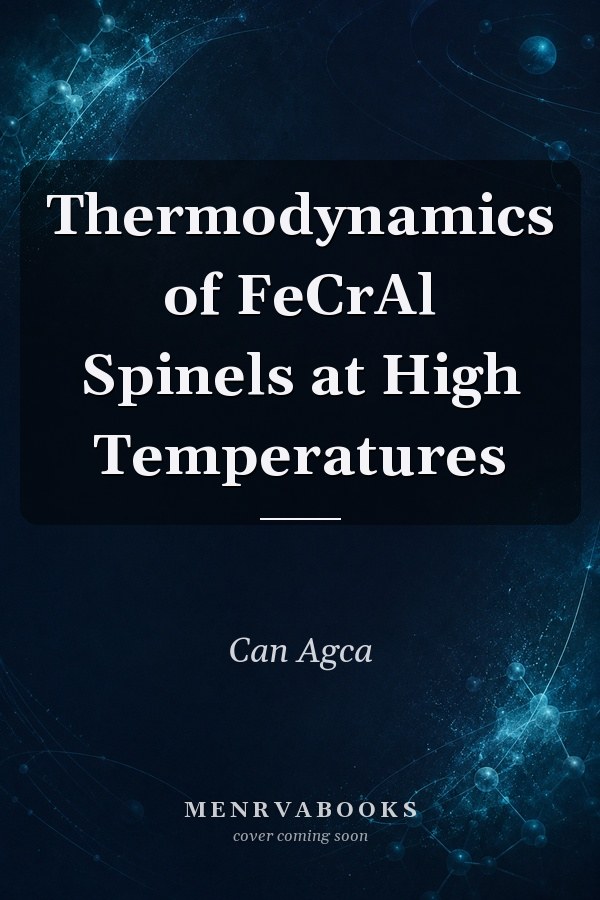
Thermodynamics of FeCrAl Spinels at High Temperatures
0
0
As an Amazon Associate and affiliate partner, Menrva Books earns from qualifying purchases. Learn more
Author Description
After the Fukushima Daiichi nuclear plant accident in Japan in 2011, loss-of-coolant accidents (LOCA) became one of the more important issues to prevent in light water nuclear reactors. In a typical LOCA, insufficient cooling water boils into steam and starts to react with zirconium alloy fuel cladding. The reaction is highly exothermic; however, the main heat in the reactor is initially released by fuel decay heat. Reaching a specific temperature, Zr oxidation rate increases so much that a runaway reaction occurs. At that point, the cladding temperatures spike above 2000 °C causing failure of the cladding and uranium contamination in the cooling water. Furthermore, zirconium oxidation forms hydrogen which leads to explosions upon reacting with oxygen and makes the situation much worse. In order to prevent these series of events, zirconium alloys are being replaced as fuel cladding in the light water reactors. FeCrAl alloys are considered as strong candidates for replacement cladding materials. Steam oxidations tests show that these alloys have much less heat of oxidation and do not form hydrogen in the accident. (Fe,Cr,Al)3O4 spinel solid solutions have gained interest due to their formation upon oxidation of the FeCrAl alloys. In this dissertation, high temperature thermodynamics and phase equilibrium of (Fe,Cr,Al)3O4 spinels have been investigated to provide thermochemical information that is needed in accident scenario modeling. High temperature phase equilibria have been illustrated using in situ synchrotron X-ray diffraction experiments. Corundum-FeAlO3-spinel, spinel-corundum, spinel-FeAlO3 and single-phase spinel temperature ranges have been found after refining the X-ray patterns. The spinel phase exists below melting temperatures. Lattice parameters, cation occupancies and phase composition have been determined for Fe1.5Al1.2Cr0.3O4 spinel solid solution at different temperatures. High temperature thermodynamic properties of (Fe,Al)3O4 spinels have been el
Menrva's Summary
THE THESIS
This work investigates the high-temperature thermodynamics and phase equilibrium of (Fe,Cr,Al)3O4 spinels to provide crucial thermochemical data for nuclear reactor accident scenario modeling. The research addresses the critical need for improved fuel cladding materials in light water reactors following the Fukushima accident, focusing on FeCrAl alloys as a promising alternative to zirconium alloys due to their reduced reactivity and lack of hydrogen formation during loss-of-coolant accidents. The study specifically examines the spinel solid solutions that form upon oxidation of these alloys, providing essential data for predicting and mitigating severe accident conditions.
THE SCOPE MAP
- Investigation into the thermodynamics and phase equilibria of (Fe,Cr,Al)3O4 spinels at high temperatures.
- Application of in situ synchrotron X-ray diffraction experiments to determine high-temperature phase equilibria.
- Identification of temperature ranges for corundum-FeAlO3-spinel, spinel-corundum, spinel-FeAlO3, and single-phase spinel.
- Determination of lattice parameters, cation occupancies, and phase composition for Fe1.5Al1.2Cr0.3O4 spinel solid solution across various temperatures.
- Provision of thermochemical information vital for accident scenario modeling in nuclear reactors.
THE AUTHORITY PERSPECTIVE
The research presented in this dissertation focuses on providing essential thermochemical data for FeCrAl spinel solid solutions, which are critical for understanding and modeling accident scenarios in nuclear reactors. The methodology employs advanced techniques like in situ synchrotron X-ray diffraction to elucidate high-temperature phase equilibria and material properties. The findings contribute to the ongoing efforts to develop safer and more robust fuel cladding materials for light water reactors.
Page Count:
0
Publication Date:
2020-01-01
Publisher:
University of California, Davis
ISBN-13:
9798664728002
Non-Fiction
Science
Thermodynamics
Solid state chemistry
Nuclear Engineering
Community Tags
Similar Books