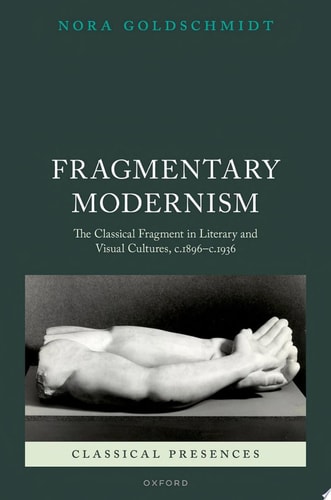
Fragmentary Modernism: The Classical Fragment in Literary and Visual Cultures, c.1896 - c.1936
0
0
As an Amazon Associate and affiliate partner, Menrva Books earns from qualifying purchases. Learn more
Author Description
Fragmentary Modernism begins from a simple observation: what has been called the 'apotheosis of the fragment' in the art and writing of modernism emerged hand in hand with a series of paradigm-shifting developments in classical scholarship, which brought an unprecedented number of fragmentary texts and objects from classical antiquity to light in modernity. Focusing primarily on the writers who came to define the Anglophone modernist canon -- Ezra Pound, T.S. Eliot, Hilda Doolittle (H.D.), and Richard Aldington, and the artists like Jacob Epstein and Henri Gaudier-Brzeska with whom they were associated -- the book plots the multiple networks of interaction between modernist practices of the fragment and the disciplines of classical scholarship. Some of the most radical writers and artists of the period can be shown to have engaged intensively with the fragments of Greek and Roman antiquity and their mediations by classical scholars. But the direction of influence also worked the other way: the modernist aesthetic of gaps, absence, and fracture came to shape how classical scholars and museum curators themselves interpreted and presented the fragments of the past to audiences in the present. From papyrology to philology, from epigraphy to archaeology, the 'classical fragment', as we still often see it today, emerged as the joint cultural production of classical scholarship and the literary and visual cultures of modernism.
Menrva's Summary
THE THESIS
This book investigates how the modernist aesthetic of the fragment was co-constructed by the parallel evolution of classical scholarship and early 20th-century artistic movements. Nora Goldschmidt, a scholar of classical reception, utilizes archival research and interdisciplinary analysis to argue that the 'classical fragment' is not merely a historical artifact but a joint cultural production of modernist writers and the academic disciplines of archaeology, papyrology, and philology. By examining the reciprocal influence between scholars and artists, the text demonstrates how the modernist fascination with absence and fracture fundamentally altered the presentation and interpretation of antiquity.
THE SCOPE MAP
What You Will Find
- Analysis of the interaction between Anglophone modernist writers and classical scholarship between 1896 and 1936.
- Examination of the works of Ezra Pound, T.S. Eliot, H.D., and Richard Aldington alongside artists like Jacob Epstein and Henri Gaudier-Brzeska.
- Exploration of how modernist aesthetics influenced museum curation and the academic presentation of classical objects.
Scope Limits
- The study focuses primarily on the Anglophone modernist canon and does not provide an exhaustive survey of continental European modernist movements.
- The analysis is restricted to the period between 1896 and 1936, excluding later developments in post-war classical reception.
THE AUTHORITY PERSPECTIVE
Scholars in the field of classical reception recognize this work as a significant contribution to understanding the intersection of modernist literature and the history of classical scholarship. Readers frequently note the academic density of the prose and the precision with which the author maps the intellectual networks of the early 20th century.
Page Count:
240
Publication Date:
2024-01-01
Publisher:
Oxford University Press
ISBN-10:
0192863401
ISBN-13:
9780192863409
History
Modernism
Literary Criticism
Art History
Academic
Cultural History
Community Tags
Similar Books