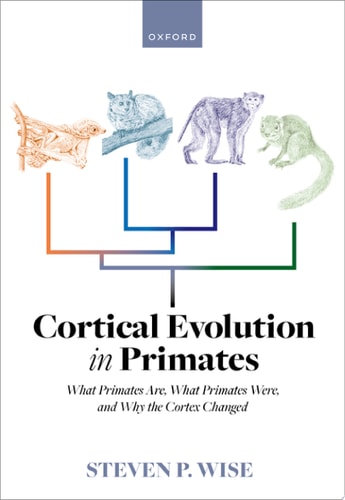
Cortical Evolution in Primates: What Primates Are, What Primates Were, and Why the Cortex Changed
0
0
As an Amazon Associate and affiliate partner, Menrva Books earns from qualifying purchases. Learn more
Author Description
Cortical Evolution in Primates provides a stand-alone resource for neuroscience graduate students and established neuroscientists who have an interest in cortical evolution and primates. Discussions of both cortical evolution and primates often rely on terms and concepts unfamiliar to many neuroscientists, but such readers will have no need to look elsewhere to understand the text or figures in this book.As well as reviewing the pertinent terminology and taxonomy, Wise explores the palaeontology, adaptations, and paleoecology of primates. Through summarizing a neglected source of data, fossil primates, the book harnesses the power of comparative neuroanatomy to examine how cortical maps changed during private evolution, including nine proposals on why the cortex changed. Together, these topics inform a full understanding of cortical evolution in primates. Wise concludes that the cortex expanded more recently than most neuroscientists suspect, and it happened many times. Furthermore, cortical expansion occurred independently in several major primate lineages, as ancestral primates adapted to the ecosystems of their time and place. Natural selection favored the expansion of cortical areas with neural representations that provided a selective advantage to ancestral primates in those times and those places.
Menrva's Summary
THE THESIS
This book investigates the evolutionary trajectory of the primate cortex, specifically addressing the mechanisms and timing behind its expansion across various lineages. Dr. Steven P. Wise, a specialist in neurophysiology, synthesizes data from paleontology, comparative neuroanatomy, and paleoecology to construct a framework for understanding how environmental pressures influenced neural development. The text argues that cortical expansion was a recurrent, independent phenomenon driven by natural selection in response to specific ecological niches.
THE SCOPE MAP
What You Will Find
- Analysis of fossil primate records as a primary data source for neuroanatomical reconstruction.
- Nine distinct hypotheses regarding the drivers of cortical change.
- A comprehensive review of primate taxonomy and evolutionary terminology.
- Comparative neuroanatomy mapping across multiple primate lineages.
Scope Limits
- The text does not provide an exhaustive history of non-primate mammalian brain evolution.
- It does not focus on modern clinical neurosurgery or current human-specific neurological pathologies.
THE AUTHORITY PERSPECTIVE
Experts recognize this work as a specialized resource that bridges the gap between paleontological data and modern neuroscientific theory. Readers frequently note the academic density of the prose, which is designed to provide a self-contained reference for graduate-level researchers and established scientists.
Page Count:
400
Publication Date:
2024-01-01
Publisher:
Oxford University Press
ISBN-10:
019286839X
ISBN-13:
9780192868398
Science
New Used & Rental Textbooks
Counseling Psychology
Paleontology
Evolutionary Biology
Cognitive
Anatomy
Primatology
Evolution
Neuroscience
Community Tags
Similar Books