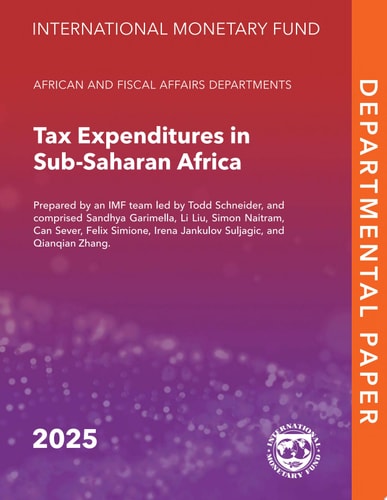
Tax Expenditures in Sub-Saharan Africa
0
0
As an Amazon Associate and affiliate partner, Menrva Books earns from qualifying purchases. Learn more
Author Description
Tax expenditures in sub-Saharan Africa (SSA) are less well understood than in other regions and in some cases represent a significant element of fiscal policy. Tax expenditures involve provisions within tax systems that reduce tax liability relative to a benchmark and can include tax exemptions, deductions, credits, or preferential rates, and can impact revenue collection, equity, and governance. This paper seeks to shed light on tax expenditures in sub-Saharan Africa (SSA), draw attention to the presence of significant data gaps, transparency, and governance issues in the region, and build on studies by other institutions and agencies. It reviews how the IMF has engaged on this issue in recent years and highlights the importance of tax expenditures to macro-fiscal stability in the current liquidity-constrained environment. It also offers some practical recommendations to policymakers and external stakeholders for advancing work in this area.
Menrva's Summary
THE THESIS
This paper investigates the nature and implications of tax expenditures within Sub-Saharan African economies. Tax expenditures, defined as provisions that reduce tax liability relative to a benchmark, encompass exemptions, deductions, credits, and preferential rates, significantly impacting revenue, equity, and governance. This work aims to illuminate these fiscal mechanisms in SSA, highlighting critical data gaps, transparency issues, and governance challenges prevalent in the region. It also reviews the IMF's recent engagement on this topic and provides actionable recommendations for policymakers and external stakeholders to advance understanding and management of tax expenditures in this context.
THE SCOPE MAP
- Analysis of tax expenditures in Sub-Saharan Africa (SSA).
- Identification of significant data gaps, transparency, and governance issues in SSA's tax systems.
- Review of the IMF's engagement and approach to tax expenditures in SSA.
- Discussion of the importance of tax expenditures for macro-fiscal stability, particularly in liquidity-constrained environments.
- Practical recommendations for policymakers and external stakeholders.
THE AUTHORITY PERSPECTIVE
This paper addresses a critical but often under-examined aspect of fiscal policy in Sub-Saharan Africa. By focusing on tax expenditures, it seeks to fill a knowledge gap and draw attention to their significant impact on revenue, equity, and governance. The work is positioned to inform policymakers and external stakeholders by providing both an analysis of current challenges and practical recommendations for improvement.
Page Count:
47
Publication Date:
2025-10-07
Publisher:
International Monetary Fund
ISBN-13:
9798229023887
Politics
Economics
Non-Fiction
Public Finance
Community Tags
Similar Books