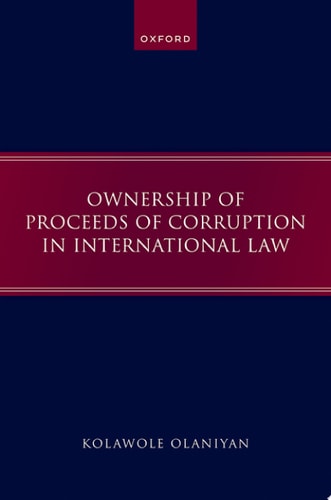
Ownership of Proceeds of Corruption in International Law
0
0
As an Amazon Associate and affiliate partner, Menrva Books earns from qualifying purchases. Learn more
Author Description
Recovery of proceeds deriving from corruption is now increasingly recognized as a principle of contemporary international law. However, people's sovereign and ownership rights over their wealth and natural resources have remained more theoretical than real, especially in the global fight against corruption. As a result, the populations of victim-states often cannot hold their governments accountable for misusing proceeds of corruption, and do not benefit from the recovery, repatriation, management, and use of returned proceeds. In the first comprehensive study on the issue, Kolawole Olaniyan challenges the conventional notion that sovereign and ownership rights over wealth and natural resources - and by extension, the proceeds of corruption - should be exclusively exercised by states.Olaniyan's Ownership of Proceeds of Corruption in International Law examines the relationship between the right to wealth and natural resources, proceeds of corruption, and economic activities. Focusing on victims of corruption, the book argues that victim-states' populations ought to be empowered to pursue grand corruption and asset recovery actions against their governments. It proposes theoretical and legal remedies for recovering proceeds of corruption, encouraging the development of domestic laws.
Menrva's Summary
THE THESIS
This book investigates the legal question of who holds the rightful ownership of proceeds recovered from corruption in the context of international law and sovereign wealth. Kolawole Olaniyan, a legal scholar, utilizes a combination of international human rights law, economic theory, and comparative legal analysis to challenge the traditional state-centric model of asset recovery. He argues that the current framework fails to protect the populations of victim-states, proposing instead that these populations should possess the legal standing to pursue asset recovery and hold their governments accountable for the misuse of national resources.
THE SCOPE MAP
What You Will Find
- Analysis of the intersection between sovereign rights, natural resource wealth, and corruption.
- A proposed legal framework for empowering victim-state populations in asset recovery litigation.
- Examination of domestic and international legal mechanisms for the repatriation and management of stolen assets.
Scope Limits
- The text focuses primarily on the legal and theoretical dimensions of ownership rather than providing a practical manual for forensic accounting or specific investigative techniques.
THE AUTHORITY PERSPECTIVE
Legal scholars and practitioners recognize this work as a significant contribution to the discourse on international asset recovery and human rights. Experts frequently note the academic density of the prose, which serves as a foundational text for those studying the intersection of corruption and international law.
Page Count:
400
Publication Date:
2024-01-01
Publisher:
Oxford University Press
ISBN-10:
0192867830
ISBN-13:
9780192867834
Politics
Economics
International Law
Human rights
Elections & Political Process
Law
Corruption
Community Tags
Other Editions(2)
Similar Books