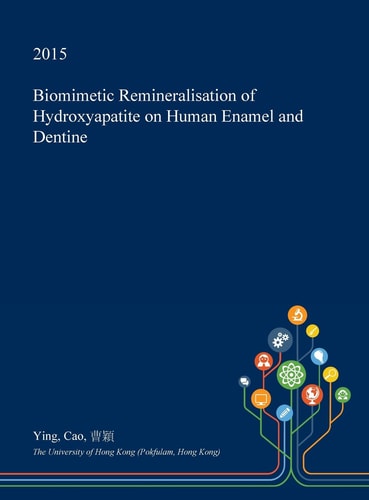
Biomimetic Remineralisation of Hydroxyapatite on Human Enamel and Dentine
0
0
As an Amazon Associate and affiliate partner, Menrva Books earns from qualifying purchases. Learn more
Author Description
This dissertation, "Biomimetic Remineralisation of Hydroxyapatite on Human Enamel and Dentine" by Ying, Cao,, was obtained from The University of Hong Kong (Pokfulam, Hong Kong) and is being sold pursuant to Creative Commons: Attribution 3.0 Hong Kong License. The content of this dissertation has not been altered in any way. We have altered the formatting in order to facilitate the ease of printing and reading of the dissertation. All rights not granted by the above license are retained by the author. Abstract: Dental enamel is the highly mineralised tissue made up of approximately 95% hydroxyapatite. As the outermost layer of teeth, enamel is susceptible to caries due to the products of bacteria metabolism; or can be lost by trauma or by non-carious tooth loss resulting from dental erosion, attrition, abrasion or acidic foods. As the enamel lesions progress into dentine, tooth hypersensitivity often develops when the exposed dentine is subjected to stimuli. Traditional treatments include replacing the defected tooth structure with dental restorative materials such as amalgam, composite resin, and ceramics. However, marginal leakage, hypersensitivity and secondary caries often happens at the interface. Therefore, there is a need for scientists to design an alternative strategy to repair the tooth lesions. Biomineralisation process is an organic matrix-mediated non-classical crystallization pathway. Biomimetic mineralisation is concepts from biomineralisation trying to transfer biomineralisation principles to the regeneration of new biomaterials. This study systematically reviewed the laboratory methods on biomimetic mineralisation of demineralised human enamel and dentine, respectively. Many studies reported success in biomimetic mineralisation of enamel and dentine. However, there still exist some problems in the biomimetic mineralisation of enamel and dentine, such as remineralisation conducted under non-physiological conditions, potential contamination i
Menrva's Summary
THE THESIS
This dissertation investigates the biomimetic remineralisation of hydroxyapatite on human enamel and dentine as an alternative strategy to traditional dental restorative materials. The study reviews laboratory methods for biomimetic mineralisation of demineralised tooth structures, addressing challenges such as non-physiological conditions and potential contamination. It aims to explore how principles from biomineralisation can be applied to regenerate biomaterials for repairing tooth lesions, a critical area given the susceptibility of enamel to caries and loss through various mechanisms. The research focuses on developing a more effective approach than current methods like amalgam, composite resin, and ceramics, which often lead to issues like marginal leakage and secondary caries.
THE SCOPE MAP
- A systematic review of laboratory methods for biomimetic mineralisation of demineralised human enamel.
- A systematic review of laboratory methods for biomimetic mineralisation of demineralised human dentine.
- Analysis of success and remaining problems in biomimetic mineralisation of enamel and dentine.
- Discussion of non-physiological conditions and potential contamination in remineralisation processes.
- Exploration of hydroxyapatite's role in dental enamel and its susceptibility to damage.
- Comparison of biomimetic strategies with traditional restorative materials (amalgam, composite resin, ceramics).
THE AUTHORITY PERSPECTIVE
This dissertation presents a detailed review of biomimetic remineralisation techniques for dental tissues. The research focuses on the scientific principles behind repairing enamel and dentine lesions, offering an alternative to conventional restorative methods. The work highlights existing successes while also identifying areas for improvement, such as conducting remineralisation under physiological conditions and mitigating contamination risks. The study is grounded in the understanding of hydroxyapatite's composition and the vulnerabilities of tooth structure.
Page Count:
0
Publication Date:
2017-01-26
Publisher:
BiblioBazaar
ISBN-10:
1361037172
ISBN-13:
9781361037171
Science
Non-Fiction
Biomaterials
Community Tags
Similar Books


Reader Comments
Share Your Thoughts
No comments yet. Be the first to share your thoughts!