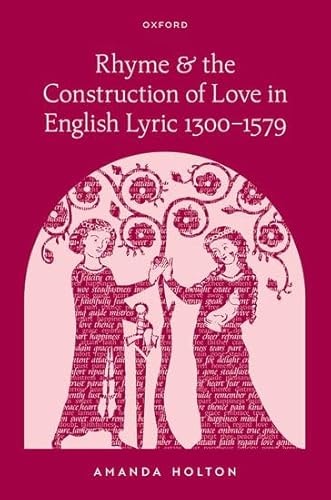
Rhyme and the Construction of Love in English Lyric 1300–1579
0
0
As an Amazon Associate and affiliate partner, Menrva Books earns from qualifying purchases. Learn more
Author Description
This Book, Which Is Underpinned By A Database Of All The Rhymes In C. 925 Courtly Love Lyrics Produced Between 1300 And 1579, Demonstrates That Rhyme Is Far From Being A Superficial Decorative Feature: Instead Rhyme Fundamentally Determines And Structures Subject-matter. The Book Focuses In Particular On The Relationship Between Rhyme And The Ideas About Love In Courtly Lyrics Between 1300 And 1579, Spanning The Periods Traditionally Divided Into 'medieval' And 'early Modern'. Concentrating On The Rhyme-groups Surrounding The Words 'pain', 'woe' And 'heart', It Argues That The Limited Rhyme Resources Of English Render Certain Clusters Of Words And Ideas Almost Inevitable, Particularly In Forms Like The Ballade And The Roundel, Which Are Hungry For Very Large Rhyme-groups. The Result Is That Groups Of Ideas Which Are Linked By The Essentially Arbitrary Element Of Rhyme Come To Determine The Characteristics Of Love In Poetry, While The Impression Of Subjectivity Emerges As A Side-effect Of Rhyme's Requirements. The Book Is Controversial In Its Argument That Content Is A Side-effect Of Form, And Poses Fundamental Challenges To The Critical Status Quo. Although A Handful Of Earlier Critics Like Hugh Kenner Have Raised The Idea Of The Constitutive Power Of Rhyme, This Has Never Been The Subject Of A Monograph, And This Book Is Unique In Its Marrying Of These Ideas With A Data-driven Approach. In Its Distinctive Way, It Contributes To The Ongoing Critical Movement Which Aims To Break Down Period Boundaries Between The Medieval And Early Modern. It Allows The Study Of Often-neglected Material, And It Also Maps Aspects Of The Literary Landscape Inherited By Poets Like Sidney, Spenser And Shakespeare-- Provided By Publisher.
Menrva's Summary
THE THESIS
This book investigates the extent to which the formal constraints of rhyme dictate the thematic content and conceptual development of English courtly love lyrics between 1300 and 1579. Amanda Holton, a scholar of medieval and early modern literature, utilizes a comprehensive database of over 900 lyrics to challenge the traditional view that rhyme is merely a decorative element. She argues that the limited rhyming resources of the English language forced poets into specific semantic clusters, effectively making the expression of love a byproduct of structural necessity rather than purely individual sentiment.
THE SCOPE MAP
What You Will Find
- A quantitative analysis of rhyme-groups associated with the terms 'pain', 'woe', and 'heart'.
- An examination of fixed poetic forms such as the ballade and the roundel.
- A comparative study spanning the transition from the medieval period to the early modern era.
Scope Limits
- The analysis is restricted to courtly love lyrics and does not address other poetic genres or secular verse outside this specific tradition.
THE AUTHORITY PERSPECTIVE
Scholars recognize this work as a significant intervention in literary studies for its data-driven methodology and its challenge to the traditional separation of medieval and early modern periods. Readers frequently note the academic density of the prose, which is intended for specialists in prosody and historical linguistics.
Page Count:
272
Publication Date:
2025-05-06
Publisher:
Oxford University Press
ISBN-10:
0192873547
ISBN-13:
9780192873545
Poetry
Criticism & Theory
English literature
Literary Criticism
Linguistics
Early Modern
Community Tags
Similar Books