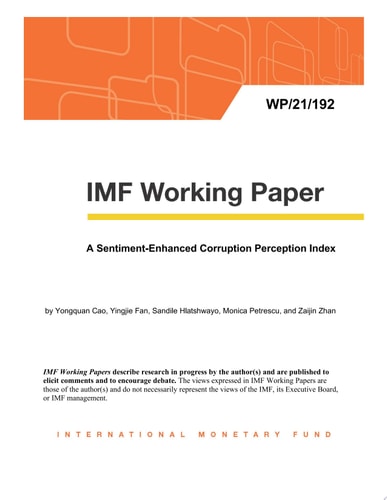
A Sentiment-Enhanced Corruption Perception Index
0
0
As an Amazon Associate and affiliate partner, Menrva Books earns from qualifying purchases. Learn more
Author Description
Direct measurement of corruption is difficult due to its hidden nature, and measuring the perceptions of corruption via survey-based methods is often used as an alternative. This paper constructs a new non-survey based perceptions index for 111 countries by applying sentiment analysis to Financial Times articles over 2005–18. This sentiment-enhanced corruption perception index (SECPI) captures not only the frequncy of corruption related articles, but also the articles’ sentiment towards corruption. This index, while correlated with existing corruption perception indexes, offers some distinct advantages, including heightened sensitivity to current events (e.g., corruption investigations and elections), availability at a higher frequency, and lower costs to update. The SECPI is negatively correlated with business environment and institutional quality. Increases in the perceived incidence or scope of corruption influences economic agents’ behaviors, and thus economic dynamics. We found that when the SECPI is at least one standard deviation above the mean, the growth per capita falls by 0.65 percentage point on average, with more pronounced impacts for emerging market and low income countries.
Menrva's Summary
THE THESIS
This paper introduces a novel method for measuring corruption perception by analyzing sentiment in financial news articles. The authors construct a sentiment-enhanced corruption perception index (SECPI) for 111 countries using Financial Times articles from 2005 to 2018. This index accounts for both the frequency and the sentiment expressed in articles related to corruption, offering a more dynamic and cost-effective alternative to traditional survey-based methods. The SECPI demonstrates heightened sensitivity to current events and provides a more frequent data stream, correlating negatively with business environment and institutional quality.
THE SCOPE MAP
- A non-survey based perceptions index for 111 countries, the Sentiment-Enhanced Corruption Perception Index (SECPI).
- Application of sentiment analysis to Financial Times articles spanning 2005–18.
- Measurement capturing both the frequency and sentiment of corruption-related articles.
- Analysis of the SECPI's correlation with existing corruption perception indexes and its distinct advantages (sensitivity to current events, higher frequency, lower cost).
- Examination of the SECPI's negative correlation with business environment and institutional quality.
- Empirical findings on the impact of SECPI increases on per capita growth, particularly in emerging market and low-income countries.
THE AUTHORITY PERSPECTIVE
This research presents a novel methodological approach to quantifying corruption perception by leveraging sentiment analysis on news media. The proposed Sentiment-Enhanced Corruption Perception Index (SECPI) offers distinct advantages over traditional survey methods, including greater sensitivity to real-time events and higher data frequency. The study empirically demonstrates the index's negative correlation with economic indicators like business environment and institutional quality, and quantifies its impact on per capita growth, suggesting its utility for economic analysis and policy-making.
Page Count:
26
Publication Date:
2021-07-23
Publisher:
International Monetary Fund
ISBN-10:
1513588885
ISBN-13:
9781513588889
Non-Fiction
Economics
Politics
International relations
Data Analysis
Community Tags
Similar Books