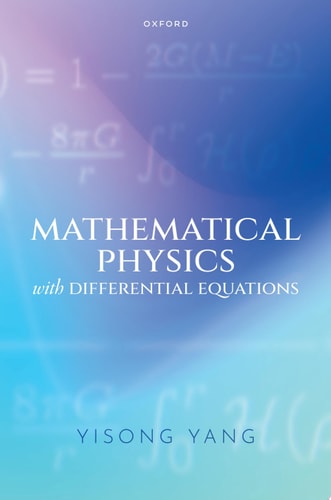
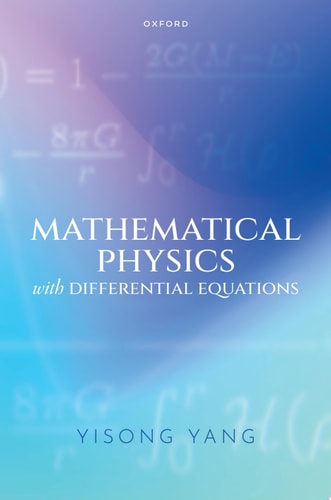
Mathematical Physics with Differential Equations
0
0
As an Amazon Associate and affiliate partner, Menrva Books earns from qualifying purchases. Learn more
Author Description
Traditional literature in mathematical physics is clustered around classical mechanics, especially fluids and elasticity. This book reflects the modern development of theoretical physics in the areas of field theories: classical, quantum, and gravitational, in which differential equations play essential roles and offer powerful insight. Yang here presents a broad range of fundamental topics in theoretical and mathematical physics based on the viewpoint of differential equations.The subject areas covered include classical and quantum many-body problems, thermodynamics, electromagnetism, magnetic monopoles, special relativity, gauge field theories, general relativity, superconductivity, vortices and other topological solitons, and canonical quantization of fields, for which knowledge and use of linear and nonlinear differential equations are essential for comprehension. Much emphasis is given to the mathematical and physical content offering an appreciation of the interplay of mathematics and theoretical physics from the viewpoint of differential equations. Advanced methods and techniques of modern nonlinear functional analysis are kept to a minimum and each chapter is supplemented with a collection of exercises of varied depths making it an ideal resource for students and researchers alike.
Menrva's Summary
THE THESIS
This text investigates the role of linear and nonlinear differential equations as the primary analytical framework for understanding modern theoretical physics. Author Yisong Yang, an expert in the field, synthesizes complex physical phenomena through the lens of mathematical rigor. The book argues that differential equations provide the most effective language for describing field theories, ranging from classical mechanics to general relativity. By focusing on this mathematical foundation, the author provides a unified approach to diverse physical systems.
THE SCOPE MAP
What You Will Find
- Coverage of classical and quantum many-body problems, thermodynamics, and electromagnetism.
- Analysis of gauge field theories, general relativity, and superconductivity.
- Examination of topological solitons and canonical quantization of fields.
- A collection of exercises at the end of each chapter for pedagogical application.
Scope Limits
- The text intentionally minimizes the use of advanced nonlinear functional analysis to maintain accessibility.
- It does not provide an exhaustive historical account of physics, focusing instead on the mathematical mechanics of the theories presented.
THE AUTHORITY PERSPECTIVE
Experts and students identify this work as a bridge between pure mathematics and theoretical physics applications. Readers frequently note that the text is well-suited for those seeking to understand the mathematical underpinnings of field theories without becoming overwhelmed by excessive functional analysis.
Page Count:
496
Publication Date:
2023-10-27
Publisher:
Oxford University Press
ISBN-10:
0192872613
ISBN-13:
9780192872616
Physics
Mathematics
Mathematical Physics
Theoretical Physics
Academic
Community Tags
Other Editions(3)
Similar Books