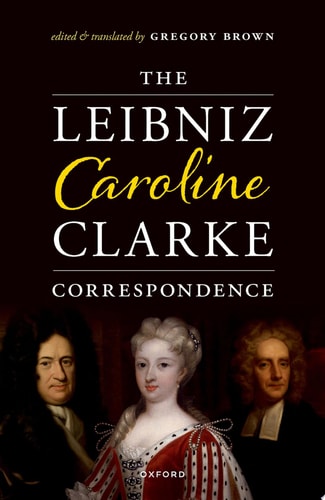
The Leibniz-Caroline-Clarke Correspondence
0
0
As an Amazon Associate and affiliate partner, Menrva Books earns from qualifying purchases. Learn more
Author Description
This volume focuses on the famous philosophical correspondence between the German polymath Gottfried Wilhelm Leibniz, writing in the final months of his life, and the English philosopher and cleric Samuel Clarke, as well as the correspondence between Leibniz and Caroline of Brandenburg-Ansbach, future Princess of Wales and Queen Consort of England, who played a significant role in the correspondence as both mediator of, and commentator on, the exchanges been Leibniz and Clarke. It provides a complete reproduction of Samuel Clarke's 1717 edition of his correspondence with Leibniz, as well as original language texts (in French and Latin) and English translations of the extant correspondence between Leibniz and Caroline from 1714 to 1716, as well as many of the letters exchanged between Leibniz and various correspondents during the period of the correspondence with Clarke. Many of the original language documents are here published and translated into English for the first time.Gregory Brown's introduction places the letters in historical and personal context. The first part discusses the correspondence and developing relationship between Caroline and Leibniz. This encompasses a period immediately leading up to the ascension of Caroline's father-in-law, Georg Ludwig, Elector of Braunschweig-Lüneburg (Hanover), to the throne of England as George I following the death of Queen Anne, as well as Caroline's ascension to the position of Princess of Wales and subsequent relocation to England, Leibniz's correspondence with Clarke, mediated by Caroline, and Leibniz's death in 1716. The second part of the introduction discusses the main themes of the correspondence between Leibniz and Clarke and highlights the importance and influence of Caroline in her role as mediator of the correspondence.
Menrva's Summary
THE THESIS
This volume investigates the intellectual exchange between Gottfried Wilhelm Leibniz, Samuel Clarke, and Caroline of Brandenburg-Ansbach to clarify the philosophical and political tensions of the early 18th century. Gregory Brown, an expert in early modern philosophy, provides a scholarly framework that contextualizes these letters within the transition of the Hanoverian succession. By presenting both the 1717 Clarke edition and previously untranslated correspondence with Caroline, the work argues that Caroline served as a critical mediator whose influence shaped the trajectory of the Leibniz-Clarke debate.
THE SCOPE MAP
What You Will Find
- A complete reproduction of the 1717 Samuel Clarke edition of the Leibniz-Clarke correspondence.
- Original language texts in French and Latin alongside new English translations of letters between Leibniz and Caroline.
- Historical analysis of the political climate surrounding the ascension of George I.
- Scholarly introduction detailing the personal and intellectual relationships between the three primary figures.
Scope Limits
- The text focuses primarily on the specific period between 1714 and 1716.
- It does not provide a comprehensive biography of Leibniz or Clarke outside of their interactions with the Princess.
THE AUTHORITY PERSPECTIVE
Scholars and historians recognize this volume as a significant contribution to the study of early modern intellectual history due to its inclusion of previously untranslated primary sources. Readers frequently note the academic density of the prose, which is intended for researchers and students of philosophy rather than a general audience.
Page Count:
1008
Publication Date:
2023-01-01
Publisher:
Oxford University Press
ISBN-10:
0192870920
ISBN-13:
9780192870926
Philosophy
Political Philosophy
Epistolary
Philosophy Modern
Philosophy history
Correspondence
Early Modern
Community Tags
Similar Books