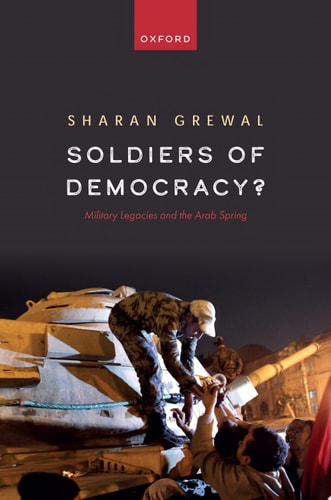
Soldiers of Democracy?: Military Legacies and the Arab Spring
0
0
As an Amazon Associate and affiliate partner, Menrva Books earns from qualifying purchases. Learn more
Author Description
Why do some militaries support and others thwart transitions to democracy? After the Arab Spring revolutions, why did Egypt's military stage a coup to end the transition? Conversely, why did Tunisia's military initially support the transition, only to later facilitate the elected president's dismantling of democracy?In Soldiers of Democracy? Military Legacies and the Arab Spring, Sharan Grewal argues that a military's behavior under democracy is shaped by how it had been treated under autocracy. Autocrats who had empowered their militaries produce soldiers who will repress protests and stage coups to preserve their privileges. Meanwhile, autocrats who had marginalized their militaries produce soldiers who support democratization, but who are also more susceptible to incumbent takeovers and civil wars. The dictator's choice to either empower or marginalize the military thus creates legacies that shape both the likelihood of democratization and the forms by which it breaks down.Drawing on over 140 interviews with civilian and military leaders, and three surveys of military personnel, this scholarly volume illustrates this theory through detailed case studies of Egypt and Tunisia. Grewal also probes the generalizability of the theory through a cross-national analysis of all countries between 1946-2010. Overall, he brings the military front and center to the study of democratic transition and consolidation.
Menrva's Summary
THE THESIS
This book investigates the causal relationship between the treatment of military institutions under autocratic rule and their subsequent behavior during democratic transitions. Dr. Sharan Grewal, a political scientist, utilizes a framework that categorizes autocratic strategies into military empowerment or marginalization. He argues that these historical legacies dictate whether a military will act as a guardian of democracy, a perpetrator of coups, or a facilitator of authoritarian backsliding.
THE SCOPE MAP
What You Will Find
- A comparative analysis of military behavior in Egypt and Tunisia post-Arab Spring.
- A cross-national statistical analysis of global democratic transitions from 1946 to 2010.
- A theoretical framework linking autocratic institutional design to post-transition military loyalty.
Scope Limits
- The study focuses primarily on the military's role in democratic transitions and does not provide an exhaustive history of the Arab Spring protests themselves.
- The analysis is restricted to the specific institutional legacies of the military, excluding broader socio-economic factors that may influence political stability.
THE AUTHORITY PERSPECTIVE
Scholars in the field of comparative politics identify this work as a rigorous contribution to the study of civil-military relations. Readers frequently note the academic density of the prose and the depth of the primary source data, which makes it a significant resource for understanding the failure of democratic transitions in the Middle East.
Page Count:
352
Publication Date:
2023-01-01
Publisher:
Oxford University Press
ISBN-10:
0192873911
ISBN-13:
9780192873910
Middle Eastern
Military History
International relations
Community Tags
Similar Books