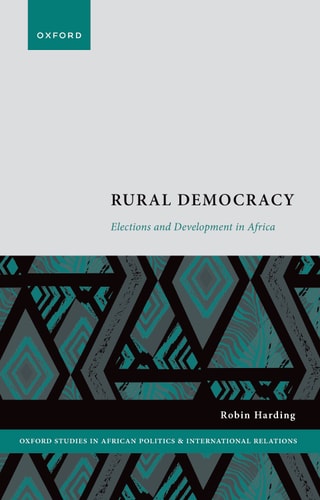
Rural Democracy: Elections and Development in Africa
0
0
As an Amazon Associate and affiliate partner, Menrva Books earns from qualifying purchases. Learn more
Author Description
How have African rulers responded to the introduction of democratic electoral competition? Despite the broadly negative picture painted by the prevailing focus on electoral fraud, clientelism, and ethnic conflict, the book argues that the full story is somewhat more promising. While these unfortunate practices may be widespread, African rulers also seek to win votes through the provision and distribution of public goods and services. The author's central argument is that in predominantly rural countries the introduction of competitive elections leads governments to implement pro-rural policies, in order to win the votes of the rural majority. As a result, across much of Africa the benefits of democratic electoral competition have accrued primarily in terms of rural development. This broad claim is supported by cross-national evidence, both from public opinion surveys and from individual level data on health and education outcomes. The argument's core assumptions about voting behavior are supported with quantitative evidence from Ghana, and qualitative historical evidence from Botswana presents further evidence for the underlying theoretical mechanism. Taken together, this body of evidence provides reasons to be optimistic about the operation of electoral accountability in Africa. African governments are responding to the accountability structures provided by electoral competition; in that sense, democracy in Africa is working.Oxford Studies in African Politics and International Relations is a series for scholars and students working on African politics and International Relations and related disciplines. Volumes concentrate on contemporary developments in African political science, political economy, and International Relations, such as electoral politics, democratization, decentralization, the political impact of natural resources, the dynamics and consequences of conflict, and the nature of the continent's engagement with the East and West. Comparative and mixed m
Menrva's Summary
THE THESIS
Does the introduction of competitive elections in African nations incentivize governments to prioritize rural development? Robin Harding, a scholar of African political economy, posits that electoral competition forces governments to cater to the rural majority to secure votes. By analyzing cross-national data alongside specific case studies, the author argues that democratic accountability in Africa manifests through the tangible provision of public goods and services in rural areas.
THE SCOPE MAP
What You Will Find
- Cross-national analysis of public opinion surveys and health and education outcomes.
- Quantitative evidence regarding voting behavior derived from Ghana.
- Qualitative historical analysis of political mechanisms in Botswana.
Scope Limits
- The study focuses primarily on rural development outcomes rather than urban-centric political dynamics.
- The research does not extensively cover non-democratic regimes or the nuances of conflict-ridden states.
THE AUTHORITY PERSPECTIVE
Scholars in the field of African politics recognize this work as a significant contribution to the study of electoral accountability and public policy distribution. Experts frequently cite the book for its balanced use of quantitative data and historical context to challenge prevailing narratives regarding democratic failure in the region.
Page Count:
192
Publication Date:
2022-12-15
Publisher:
Oxford University Press
ISBN-10:
0192882058
ISBN-13:
9780192882059
Politics
Systems Theory
New Used & Rental Textbooks
World politics
Specific Topics
International relations
Elections & Political Process
Community Tags
Similar Books