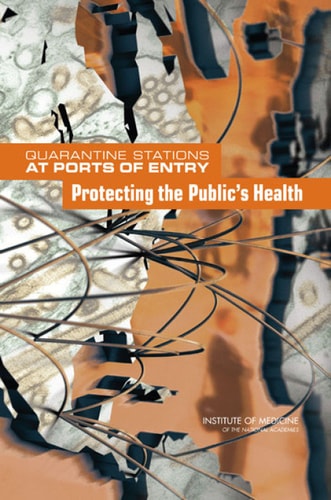
Quarantine Stations at Ports of Entry Protecting the Public's Health
0
0
As an Amazon Associate and affiliate partner, Menrva Books earns from qualifying purchases. Learn more
Author Description
To mitigate the risks posed by microbial threats of public health significance originating abroad, the Centers for Disease Control and Prevention (CDC) places small groups of staff at major U.S. airports. These staff, their offices, and their patient isolation rooms constitute quarantine stations, which are run by CDC's Division of Global Migration and Quarantine (DGMQ). Congress began to allocate funds in fiscal 2003 for the establishment of new quarantine stations at 17 major U.S. ports of entry that comprise airports, seaports, and land-border crossings. In a significant departure from the recent past, both the preexisting 8 quarantine stations and the new 17 are expected to play an active, anticipatory role in nationwide biosurveillance. Consequently, DGMQ asked the Institute of Medicine (IOM) to convene an expert committee to assess the present CDC quarantine stations and recommend how they should evolve to meet the challenges posed by microbial threats at the nation's gateways. DGMQ specifically requested "an assessment of the role of the federal quarantine stations, given the changes in the global environment including large increases in international travel, threats posed by bioterrorism and emerging infections, and the movement of animals and cargo." To conduct this assessment and provide recommendations, IOM convened, in October 2004, the Committee on Measures to Enhance the Effectiveness of the CDC Quarantine Station Expansion Plan for U.S. Ports of Entry. At the sponsor's request, the committee released the interim letter report Human Resources at U.S. Ports of Entry to Protect the Public's Health in January 2005 to provide preliminary suggestions for the priority functions of a modern quarantine station, the competences necessary to carry out those functions, and the types of health professionals who have the requisite competences (Appendix A). This, the committee's final report, assesses the present role of the CDC quarantine stati
Menrva's Summary
THE THESIS
The expansion of U.S. quarantine stations at ports of entry is assessed for its effectiveness in protecting public health against global microbial threats. The Centers for Disease Control and Prevention (CDC) operates quarantine stations, staffed by small teams, at major U.S. airports, seaports, and land-border crossings, with a recent expansion to 17 new stations. These stations are intended to play an active role in nationwide biosurveillance, a departure from their previous function. The Institute of Medicine (IOM) was tasked by the CDC's Division of Global Migration and Quarantine (DGMQ) to evaluate these stations and recommend improvements to address challenges posed by increased international travel, bioterrorism, emerging infections, and the movement of animals and cargo. This report details the committee's assessment and recommendations for enhancing the CDC's quarantine station expansion plan.
THE SCOPE MAP
- Assessment of the current role and effectiveness of CDC quarantine stations at U.S. ports of entry.
- Analysis of the evolving global environment, including increased international travel and emerging infectious diseases.
- Evaluation of threats posed by bioterrorism and their implications for quarantine measures.
- Consideration of the movement of animals and cargo as potential vectors for disease transmission.
- Recommendations for enhancing the effectiveness of the CDC's quarantine station expansion plan.
- Discussion of the necessary competences and health professionals required for modern quarantine stations.
- Examination of the priority functions for a modern quarantine station.
THE AUTHORITY PERSPECTIVE
This report, commissioned by the CDC's Division of Global Migration and Quarantine, provides a comprehensive assessment of U.S. quarantine stations and offers recommendations for their future development. The Institute of Medicine's committee convened experts to address the challenges posed by global health threats at the nation's gateways. The findings are intended to inform policy and operational improvements for biosurveillance and public health protection. The report builds upon an interim letter report that offered preliminary suggestions on human resources and essential competences.
Page Count:
334
Publication Date:
2006-02-09
Publisher:
National Academies Press
ISBN-10:
030916494X
ISBN-13:
9780309164948
Non-Fiction
Science
Emergency Preparedness
Public Health
Government Policy
Community Tags
Similar Books






Reader Comments
Share Your Thoughts
No comments yet. Be the first to share your thoughts!