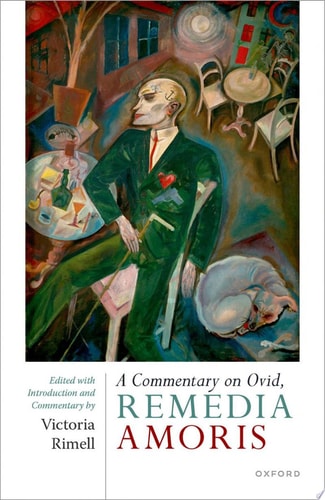
A Commentary on Ovid, Remedia Amoris: Edited with Introduction and Commentary
0
0
As an Amazon Associate and affiliate partner, Menrva Books earns from qualifying purchases. Learn more
Author Description
The Ovidian Renaissance seems to have left the Remedia Amoris behind. The poem has remained marginal, read either as a reversal of the Ars Amatoria's teaching that brings the world of Ovidian elegy to a banal end, or as an over-determined supplement to the Ars which ironically fails in its ostensible aim of 'curing' the dissatisfied lover. While recent work has explored how the poem functions not just as a palinode to, but also as a continuation of, the Ars, the critical status quo continues to present it as a minor appendage rather than as an important chapter in Ovid's project as a poet of desire. Victoria Rimell's commentary resets critical perspectives by reading the Remedia as distinctive and original, and as a pivotal text within Ovid's oeuvre as a whole. In her immersive, creatively interpretative guide to the poem, the Remedia emerges as an intricate work that interacts with medical texts, works on rhetoric, law, magic and ritual, philosophical thinking about self-discipline, the irrational, consolation and therapy for the soul, as well as with Greco-Roman satire, lyric, epigram, and traditions of didactic and erotodidactic verse. The poem, Rimell argues, is a key node in Ovid's development of a poetics of paradox, reversibility, and auto-immunity.
Menrva's Summary
THE THESIS
This work investigates the critical marginalization of Ovid's Remedia Amoris, arguing that the poem serves as a pivotal, complex text rather than a minor appendage to the poet's larger body of work. Victoria Rimell, a scholar of Latin literature, utilizes a multidisciplinary framework to re-evaluate the poem's status. By analyzing the text through the lenses of rhetoric, philosophy, and medical history, she posits that the Remedia is a sophisticated exploration of desire, self-discipline, and the poetics of paradox.
THE SCOPE MAP
What You Will Find
- A comprehensive line-by-line commentary on the Remedia Amoris
- Analysis of the poem's interaction with Greco-Roman satire, lyric, and didactic verse
- Examination of the text's relationship to medical, legal, and ritualistic discourses
- A re-evaluation of Ovid's poetics of auto-immunity and reversibility
Scope Limits
- The text does not provide a general biography of Ovid outside the context of his didactic poetry
- It does not offer a broad survey of Roman history beyond the specific literary and philosophical traditions relevant to the poem
THE AUTHORITY PERSPECTIVE
Scholars and students of classical literature view this commentary as a significant intervention in Ovidian studies that challenges traditional interpretations of the poet's later work. Readers frequently note the academic density of the prose and the depth of the intertextual analysis provided by the author.
Page Count:
448
Publication Date:
2024-01-01
Publisher:
Oxford University Press
ISBN-10:
0192894218
ISBN-13:
9780192894212
Poetry
Ancient - Rome
Criticism & Theory
Academic
Literary Criticism
Community Tags
Similar Books