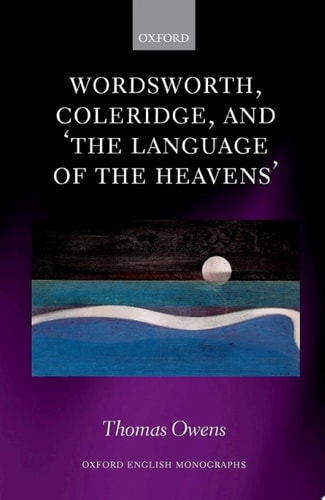
Wordsworth, Coleridge, and 'the language of the heavens'
0
0
As an Amazon Associate and affiliate partner, Menrva Books earns from qualifying purchases. Learn more
Author Description
Thomas Owens explores some of the exultant visions inspired by Wordsworth's and Coleridge's close scrutiny of the night sky, the natural world, and the domains of science. He examines a set of scientific patterns drawn from natural, geometric, celestial, and astronomical sources which Wordsworth and Coleridge used to express their ideas about poetry, religion, literary criticism, and philosophy, and establishes the central importance of analogy in their creative thinking. Analogies prompted the poets' imaginings in geometry and cartography, in nature (representations of the moon) and natural history (studies of spider-webs, streams, and dew), in calculus and conical refraction, and in the discovery of infra-red and ultraviolet light. Although this is primarily a study of the patterns which inspired their writing, the findings overturn the prevalent critical consensus that Wordsworth and Coleridge did not have the access, interest, or capacity to understand the latest developments in nineteenth-century astronomy and mathematics, which they did in fact possess. Wordsworth, Coleridge, and 'the language of the heavens' reinstates many relationships which the poets had with scientists and their sources. Most significantly, the book illustrates that these sources are not simply another context or historical lens through which to engage with Wordsworth's and Coleridge's work but are instead a controlling device of the symbolic imagination. Exploring the structures behind Wordsworth's and Coleridge's poems and metaphysics stakes out a return to the evidence of the Romantic imagination, not for its own sake, but in order to reveal that their analogical configuration of the world provided them with a scaffold for thinking, an intellectual orrery which ordered artistic consciousness and which they never abandoned.
Menrva's Summary
THE THESIS
This work investigates how William Wordsworth and Samuel Taylor Coleridge integrated nineteenth-century scientific and mathematical concepts into their poetic and philosophical frameworks. Thomas Owens, an academic scholar, utilizes a rigorous analysis of the poets' correspondence, reading habits, and scientific source materials to challenge the long-standing critical assumption that these Romantic figures were detached from the scientific advancements of their era. He argues that the poets employed specific celestial, geometric, and astronomical analogies as a primary symbolic scaffold for their creative and intellectual output.
THE SCOPE MAP
What You Will Find
- Analysis of scientific patterns in Romantic poetry including calculus, conical refraction, and light spectrum discoveries.
- Examination of the role of analogy in shaping poetic imagination and metaphysical thought.
- Re-evaluation of the poets' relationships with contemporary scientists and astronomical texts.
Scope Limits
- The study does not provide a comprehensive biography of either poet.
- It focuses specifically on the intersection of science and literature rather than a general survey of Romantic aesthetics.
THE AUTHORITY PERSPECTIVE
Scholars recognize this text as a significant intervention in Romantic studies that effectively dismantles the myth of the poets' scientific illiteracy. Readers frequently note the academic density of the prose, which is intended for an audience familiar with both nineteenth-century literature and the history of science.
Page Count:
223
Publication Date:
2019-01-01
Publisher:
OUP Oxford
ISBN-10:
0192577573
ISBN-13:
9780192577573
Philosophy
History
Poetry
19th Century
Indigenous
Science History
Literary Criticism
Romanticism
Academic
Community Tags
Other Editions(3)
Similar Books

Reader Comments
Share Your Thoughts
No comments yet. Be the first to share your thoughts!