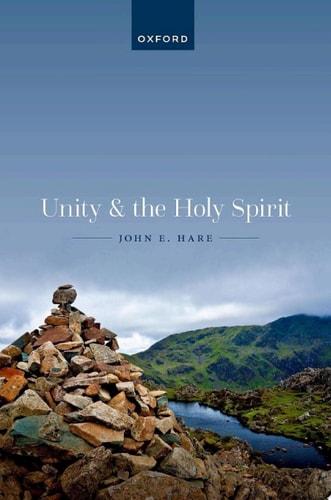
Unity and the Holy Spirit
0
0
As an Amazon Associate and affiliate partner, Menrva Books earns from qualifying purchases. Learn more
Author Description
Unity and the Holy Spirit investigates the work of the Holy Spirit in the world (as distinct from the church). John E. Hare proposes that the Spirit aims at unity of four different kinds: unity between us and the material world, unity within us, unity between us and others, and unity between us and God. The book proceeds by discussing one example of each of these kinds of unity. The example of the first is our experience of the beautiful and the sublime, examining Kant's account of these experiences with two pieces by Beethoven used as illustrations. The example of the second is gender transition, taking as a case a life assigned female at birth. Patriotism provides the third example, and the discussion examines the relation of a limited patriotism to the ideal of cosmopolitanism. The fourth example is contemplation; the discussion looks at different conceptions of this practice, starting with Aristotle. The final chapter collects together these examples, and asks what unity is in itself, starting again with Aristotle. In each case, emphasis is placed on what is contributed to our understanding by invoking the work of the Holy Spirit. The book ends by asking why the Spirit aims at unity, and the answer is that the Spirit loves. This book completes a trilogy of works on ethical theory and the doctrine of the Trinity, following The Moral Gap (OUP, 1996), about the work of the Second Person, and God's Command (OUP, 2015), about the work of the First.
Menrva's Summary
THE THESIS
This book investigates the specific role of the Holy Spirit in fostering four distinct dimensions of unity within the world, independent of the institutional church. John E. Hare, a philosopher and theologian, utilizes a framework that bridges classical philosophical inquiry with Christian doctrine. By examining specific case studies—ranging from aesthetic experience to gender transition and patriotism—he argues that the Spirit acts as a unifying force driven by love, ultimately seeking to reconcile the human experience with the divine.
THE SCOPE MAP
What You Will Find
- A philosophical examination of unity through four lenses: material, internal, interpersonal, and divine.
- Analysis of Kantian aesthetics using Beethoven's compositions as illustrative examples.
- Ethical discussions regarding gender transition and the tension between patriotism and cosmopolitanism.
- A synthesis of Aristotelian concepts of contemplation and the nature of unity.
Scope Limits
- The text does not provide a comprehensive systematic theology of the Holy Spirit.
- The analysis is limited to the four specific examples chosen by the author rather than an exhaustive survey of all potential manifestations of unity.
THE AUTHORITY PERSPECTIVE
Scholars and readers note the academic density of the prose, which requires familiarity with both Kantian and Aristotelian frameworks. Experts highlight this work as a significant concluding volume to Hare's trilogy on ethical theory and the Trinity.
Page Count:
246
Publication Date:
2022-01-01
Publisher:
OUP Oxford
ISBN-10:
0192890867
ISBN-13:
9780192890863
Spirituality
Philosophy
Metaphysics
Theology
Theology doctrinal
Christian ethics