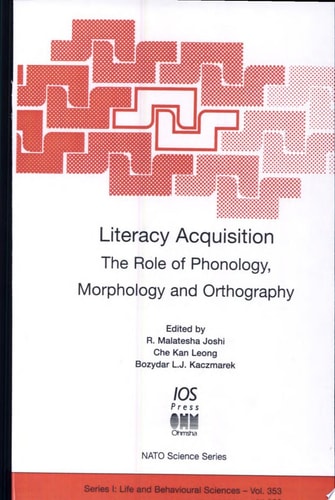
Literacy Acquisition The Role of Phonology, Morphology and Orthography
0
0
As an Amazon Associate and affiliate partner, Menrva Books earns from qualifying purchases. Learn more
Author Description
Even though comprehension is the ultimate goal of reading, word recognition skills have received a considerable amount of research attention. On the other hand, orthographic awareness, or sensitivity to the visual representation of language as it is conditioned by morphological and phonological factors, has received much less attention. This publication aims to address the nature of orthography as it relates to reading. It is divided into four sections that pertain to phonological sensitivity in reading and writing, the role of orthography in reading, spelling, and the integration of orthography and phonology in learning to read. The first section gives evidence that in addition to explicit teaching of basic decoding skills, metalinguistic knowledge or epilanguage that children bring into reading is also important. Section two presents the role of orthography from the perspective of the Dual Coding Theory (DCT) of reading, according to which cognition consists of two coding systems; one specializes for language and the other for nonverbal world knowledge. The third section deals with some research studies on spelling. It explores the relationship between reading and spelling in Spanish and show that they are inter-related. Their study also suggests that reading experience improves spelling performance. The last section deals with the integration of orthography and phonology in learning to read. It explains the orthography of Greek, Japanese, and Brahmi writing systems. It is shown that children should have some knowledge of the orthographic principles in order to become good sight word readers. From the Inside Flap Even though comprehension is the ultimate goal of reading, word recognition skills have received a considerable amount of research attention. On the other hand, orthographic awareness, or sensitivity to the visual representation of language as it is conditioned by morphological and phonological factors, ha
Menrva's Summary
THE THESIS
This publication investigates the multifaceted nature of orthographic awareness in literacy acquisition, exploring its interplay with phonological and morphological factors. The work addresses the relative lack of research attention given to orthographic awareness compared to word recognition skills, despite comprehension being the ultimate goal of reading. It is structured into four sections, examining phonological sensitivity, the role of orthography through Dual Coding Theory, research on spelling and its relationship to reading, and the integration of orthography and phonology across various writing systems like Greek, Japanese, and Brahmi. The central argument posits that knowledge of orthographic principles is crucial for developing proficient sight word readers.
THE SCOPE MAP
- Exploration of phonological sensitivity in reading and writing, highlighting the importance of metalinguistic knowledge.
- Presentation of orthography's role through the lens of Dual Coding Theory, which posits separate coding systems for language and nonverbal knowledge.
- Review of research studies on spelling, including an examination of the inter-relationship between reading and spelling in Spanish.
- Analysis of the integration of orthography and phonology in learning to read.
- Discussion of the orthographic principles of Greek, Japanese, and Brahmi writing systems.
- Evidence suggesting that children require orthographic knowledge to become effective sight word readers.
THE AUTHORITY PERSPECTIVE
This publication is presented as a scholarly examination of orthographic awareness in literacy acquisition, aiming to fill a gap in research by focusing on the visual representation of language. The structure of the book, divided into four distinct sections, suggests a comprehensive approach to the topic, moving from phonological sensitivity to the integration of orthography and phonology. The inclusion of diverse writing systems like Greek, Japanese, and Brahmi indicates a broad comparative perspective. The work appears to be targeted at researchers and educators interested in the cognitive and linguistic underpinnings of reading development.
Page Count:
217
Publication Date:
2003-01-01
Publisher:
IOS Press
ISBN-10:
1586033603
ISBN-13:
9781586033606
Psychology
Non-Fiction
Science
Education
Linguistics
Community Tags
Similar Books








Reader Comments
Share Your Thoughts
No comments yet. Be the first to share your thoughts!