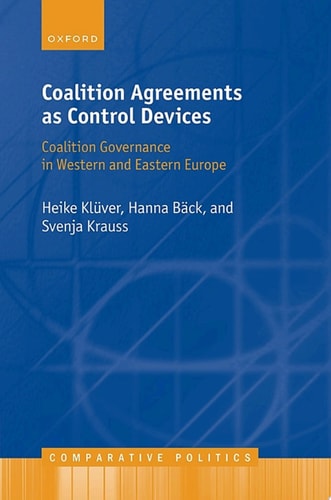
Coalition Agreements as Control Devices: Coalition Governance in Western and Eastern Europe
0
0
As an Amazon Associate and affiliate partner, Menrva Books earns from qualifying purchases. Learn more
Author Description
Many coalition cabinets negotiate lengthy coalition contracts outlining the agenda for the time in office. Not only does negotiating these agreements take up time and resources, but compromises have to be made, which may result in cabinet conflicts and electoral costs. This book explores why political parties negotiate such agreements, and argues that coalition agreements are important control devices that allow coalition parties to keep their partners in line. The authors show that their use varies with the preference configuration in cabinet and the allocation of ministerial portfolios. First, they posit that parties will only negotiate policy issues in a coalition agreement when they disagree on these issues and when they are important to all partners. Second, since controlling a ministry provides parties with important information and policy-making advantages, parties use agreements to constrain their partners particularly when they control the ministry in charge of a policy area. Finally, they argue that coalition agreements only work as effective control devices if coalition parties settle controversial issues in these contracts. The COALITIONAGREE Dataset is used to evaluate the expectations set out in the book; the dataset maps the content of 229 coalition agreements that were negotiated by 189 parties between 1945 and 2015 in 24 Western and Eastern European countries. The results show that coalition parties systematically use agreements to control their partners when policy issues are divisive and salient and when they are confronted with a hostile minister. These agreements only effectively contain conflicts, however, when parties negotiate a compromise on precisely the issues that divide them. Comparative Politics is a series for researchers, teachers, and students of political science that deals with contemporary government and politics. Global in scope, books in the series are characterized by a stress on comparative analysis and strong methodological rigor.
Menrva's Summary
THE THESIS
This book investigates the strategic function of coalition agreements as mechanisms for political control within multi-party parliamentary governments. The authors, political scientists Hanna Bäck, Heike Klüver, and Svenja Krauss, utilize a rigorous comparative framework to analyze how parties manage internal cabinet dynamics. By examining the relationship between policy preferences, ministerial portfolio allocation, and contractual negotiation, they argue that these agreements serve as essential tools for constraining coalition partners and mitigating electoral risks.
THE SCOPE MAP
What You Will Find
- The COALITIONAGREE Dataset, covering 229 agreements from 189 parties.
- Longitudinal data spanning 1945 to 2015 across 24 European nations.
- A theoretical framework linking policy salience to contractual specificity.
Scope Limits
- The analysis is restricted to Western and Eastern European parliamentary systems.
- The study focuses primarily on formal coalition contracts rather than informal governing norms.
THE AUTHORITY PERSPECTIVE
Experts recognize this work as a significant contribution to the study of coalition governance and legislative behavior. Scholars frequently cite the authors' use of the COALITIONAGREE dataset as a standard for empirical research in comparative political science.
Page Count:
426
Publication Date:
2023-01-01
Publisher:
OUP Oxford
ISBN-10:
0192899937
ISBN-13:
9780192899934
Comparative Government
Government
Public Policy
Comparative Politics
Community Tags
Similar Books




Reader Comments
Share Your Thoughts
No comments yet. Be the first to share your thoughts!