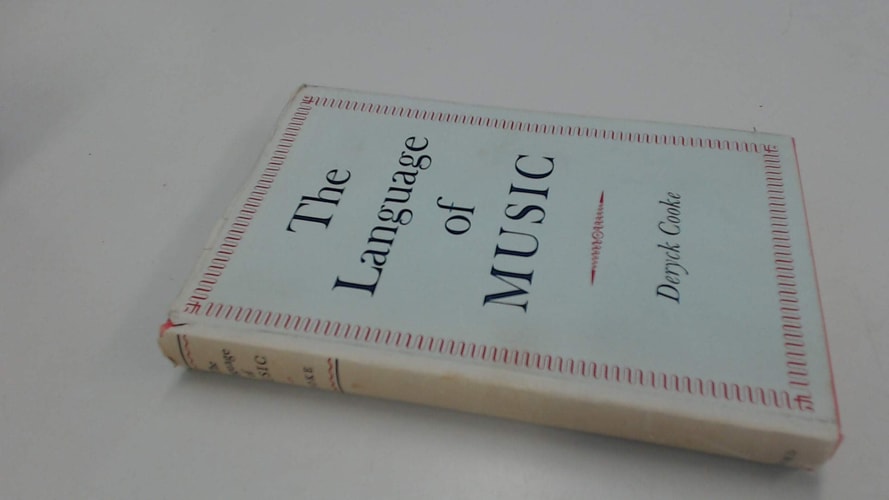
The Language of Music
0
0
As an Amazon Associate and affiliate partner, Menrva Books earns from qualifying purchases. Learn more
Author Description
This is a wide-ranging look at what sort of an art music is, and a consideration of just how it works on us emotionally. Written in 1960, it predates modern studies on music cognition yet tackles the same issues. Twentieth-century British writing on music (Cooke was English) has a refreshing practical bent to it, and this book is no exception, being a serious work written for a lay audience (albeit one able to read music--there are hundreds of short musical examples). Perhaps the book's highlight is the compendium of a number of "terms of musical vocabulary". Here Cooke identifies melodic archetypes associated with various emotional states, using mostly texted music as his supporting examples. One may accuse the author of having hand-picked his examples to support his ideas, but music, like any art, is not reducible to scientific principles, and it is uncanny that composers throughout the common-practice era would tend to use the same melodic contours to express similar emotional states. There is much more to ponder in the book than just this "dictionary" (for instance, any theorist will tackle the Tristan Prelude, and Cooke is no exception; but as he was also one of the great Wagner experts of his time, he brings a deep background to the task). As a musician and composer, I find this one of the favorite books in my library.
Menrva's Summary
THE THESIS
This work investigates the fundamental question of how music functions as a language capable of communicating specific emotional states to the listener. Deryck Cooke, a noted British musicologist and Wagner expert, utilizes a historical analysis of the common-practice era to argue that composers have consistently employed specific melodic archetypes to convey universal human emotions. By examining the structural components of musical composition, he proposes a framework for understanding music as a communicative medium rather than an abstract aesthetic experience.
THE SCOPE MAP
What You Will Find
- A comprehensive dictionary of melodic archetypes and their associated emotional expressions.
- Detailed analysis of the Tristan Prelude as a case study in musical communication.
- Hundreds of short musical examples drawn from the common-practice era.
- A practical approach to music theory designed for the musically literate layperson.
Scope Limits
- The text predates modern empirical studies in music cognition and neuroscience.
- The analysis focuses primarily on Western classical music traditions.
THE AUTHORITY PERSPECTIVE
Experts and musicians frequently cite this work as a foundational text for understanding the intersection of musical structure and emotional expression. Readers often note that while the author's selection of examples is specific to his thesis, the book remains a highly regarded resource for those interested in the historical mechanics of musical communication.
Page Count:
306
Publication Date:
1959-01-01
Publisher:
Oxford University Press
ISBN-10:
0193119056
ISBN-13:
9780193119055
Non-Fiction
Musicology
Music History
Music theory
PHILOSOPHY Aesthetics
Community Tags
Other Editions(3)

Similar Books