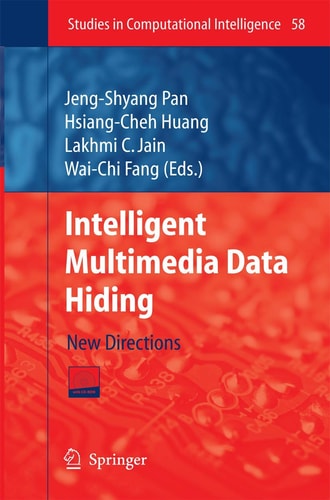
Intelligent Multimedia Data Hiding: New Directions
0
0
As an Amazon Associate and affiliate partner, Menrva Books earns from qualifying purchases. Learn more
Author Description
When the?rst watermarking papers appeared in mid 90ies, the industrial needs on copyright protection and rights management of digital media were already pressing. The music industry was already loosing large revenues due to music piracy. Watermarking was proposed as a very promising solution to combat digital piracy and illegal digital media copying. Most of the p- posed techniques have been based on solid theoretical background and, thus, attracted a large interest in the scienti?c community. The ensuing explosive growth produced rich literature, signi?cant theoretical results and IPR p- tection solutions. Besides watermarking, which is an active technique, in the sense that a watermarkmustbeembeddedinthemultimediasignal,passivetechniquesfor IPRprotectionandDRMemergedrecently.Suchtechniques(calledsometimes?ngerprinting or replica detection or perceptual hashing) are essentially fast retrieval/hashingtechniquesforbroadcast/internettra?cmonitoringthrough replica searches in copyright holder or trusted third parties databases. Watermarking is proven to be a very good solution for intellectual pr- erty rights protection, particularly for digital images. It has also been s- cessfully used for still image content authentication. Its use for video, audio and music IPR protection was less widespread, since the related technical and business model problems were proven to be more di?cult to tackle. Fing- printing/replica detection is still at its development phase and has found so far signi?cant use in music copy detection. However, there are no solutions that are yet universally acceptable.
Menrva's Summary
THE THESIS
This book explores the evolving landscape of digital media security, focusing on techniques for protecting intellectual property rights in an era of increasing piracy. It delves into both active watermarking methods, which embed data within multimedia signals, and passive techniques like fingerprinting and replica detection for monitoring digital traffic. The authors examine the historical context of these technologies, their theoretical underpinnings, and their practical applications, particularly in combating piracy and ensuring content authentication.
THE SCOPE MAP
- Overview of the historical development of digital media copyright protection and rights management.
- Detailed examination of watermarking techniques for embedding hidden data within multimedia signals.
- Exploration of passive techniques such as fingerprinting, replica detection, and perceptual hashing.
- Analysis of the application of these technologies to digital images, video, audio, and music.
- Discussion of the challenges and limitations in implementing these solutions across different media types.
- Consideration of the business models and technical hurdles associated with IPR protection.
- Current state and future directions in the field of intelligent multimedia data hiding.
THE AUTHORITY PERSPECTIVE
The book addresses the critical need for robust digital rights management and copyright protection in the face of widespread media piracy. It highlights the evolution from early watermarking techniques to more recent passive methods like fingerprinting, acknowledging that while watermarking has shown success, particularly for images, universal solutions remain elusive. The authors note the ongoing development in areas like music copy detection, suggesting that the field is dynamic and still seeking universally accepted approaches. This work provides a comprehensive overview of the technical and theoretical advancements in multimedia data hiding for intellectual property protection.
Page Count:
400
Publication Date:
2014-11-23
Publisher:
Springer Berlin Heidelberg
ISBN-10:
364242922X
ISBN-13:
9783642429224
Science & Technology
Non-Fiction
Community Tags
Similar Books