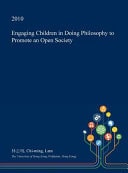
Engaging Children in Doing Philosophy to Promote an Open Society
0
0
As an Amazon Associate and affiliate partner, Menrva Books earns from qualifying purchases. Learn more
Author Description
This dissertation, "Engaging Children in Doing Philosophy to Promote an Open Society" by, Chi-ming, Lam, was obtained from The University of Hong Kong (Pokfulam, Hong Kong) and is being sold pursuant to Creative Commons: Attribution 3.0 Hong Kong License. The content of this dissertation has not been altered in any way. We have altered the formatting in order to facilitate the ease of printing and reading of the dissertation. All rights not granted by the above license are retained by the author. Abstract: Karl Popper developed a falsificationist epistemology in which knowledge grows through falsifying, or criticizing, our theories. Since criticism plays such a vital role in Popper''s falsificationist methodology, it seems natural to envisage his heuristic as a helpful resource for developing critical thinking. However, there is much controversy in the literature over the feasibility and utility of his falsificationism as a heuristic. This study argued that Popper''s falsificationism is justified on the grounds that it not only solves, theoretically, the problem of the bounds of reason in the form of comprehensively critical rationalism, but influences, practically, the research work of scientists from diverse fields. It also found that there is cause for cautious optimism about the effectiveness of falsification as a strategy for solving scientific problems. Popper''s falsificationist epistemology carries profound political and educational implications. On a political level, it is necessary to establish and maintain an open society by fostering five core values, viz. freedom, tolerance, respect, rationalism, and equalitarianism, as well as three crucial practices, viz. democracy, state interventionism, and piecemeal social engineering. On an educational level, the overriding aim is to nurture in children the requisite abilities, skills, and dispositions characteristic of critical thinking for full participation in an open democratic society. In order t
Menrva's Summary
THE THESIS
This dissertation investigates the application of Karl Popper's falsificationist epistemology as a tool for cultivating critical thinking in children to foster an open society. The author, Chi-ming Lam, draws upon Popper's theories, which posit that knowledge advances through the criticism and falsification of existing theories, to explore its practical and theoretical implications. The study examines the controversy surrounding falsificationism's utility as a heuristic while arguing for its effectiveness in solving scientific problems and its profound political and educational consequences. Ultimately, it aims to demonstrate how nurturing critical thinking skills in children can equip them for participation in a democratic and open society.
THE SCOPE MAP
- An examination of Karl Popper's falsificationist epistemology and its role in knowledge growth.
- Analysis of the controversy surrounding falsificationism as a heuristic for critical thinking.
- Arguments for the theoretical and practical justification of Popper's falsificationism.
- Exploration of the political implications for establishing and maintaining an open society through core values and practices.
- Discussion of the educational aim to develop children's critical thinking abilities for democratic participation.
THE AUTHORITY PERSPECTIVE
This academic work, a dissertation from The University of Hong Kong, presents a detailed argument for the pedagogical value of Karl Popper's falsificationist epistemology. The author, Chi-ming Lam, meticulously outlines the theoretical underpinnings and practical applications of Popper's ideas, particularly in the context of fostering critical thinking in children. The study addresses the ongoing debate regarding falsificationism's efficacy as a critical thinking heuristic, asserting its significance for both scientific advancement and the cultivation of democratic values. The work is positioned as a resource for educators and policymakers interested in developing the intellectual capacities necessary for an open society.
Page Count:
0
Publication Date:
2017-01-26
Publisher:
BiblioBazaar
ISBN-10:
1361257202
ISBN-13:
9781361257203
Philosophy
Non-Fiction
Critical thinking
Education
Community Tags
Similar Books