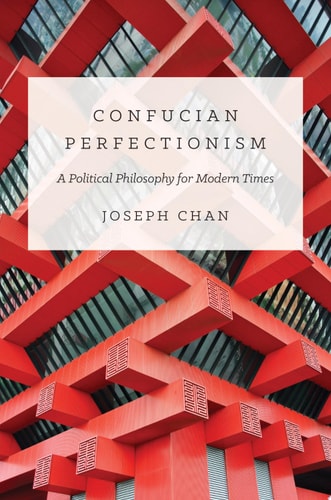
Confucian Perfectionism: A Political Philosophy for Modern Times
0
0
As an Amazon Associate and affiliate partner, Menrva Books earns from qualifying purchases. Learn more
Author Description
Since the very beginning, Confucianism has been troubled by a serious gap between its political ideals and the reality of societal circumstances. Contemporary Confucians must develop a viable method of governance that can retain the spirit of the Confucian ideal while tackling problems arising from nonideal modern situations. The best way to meet this challenge, Joseph Chan argues, is to adopt liberal democratic institutions that are shaped by the Confucian conception of the good rather than the liberal conception of the right. Confucian Perfectionism examines and reconstructs both Confucian political thought and liberal democratic institutions, blending them to form a new Confucian political philosophy. Chan decouples liberal democratic institutions from their popular liberal philosophical foundations in fundamental moral rights, such as popular sovereignty, political equality, and individual sovereignty. Instead, he grounds them on Confucian principles and redefines their roles and functions, thus mixing Confucianism with liberal democratic institutions in a way that strengthens both. Then he explores the implications of this new yet traditional political philosophy for fundamental issues in modern politics, including authority, democracy, human rights, civil liberties, and social justice. Confucian Perfectionism critically reconfigures the Confucian political philosophy of the classical period for the contemporary era.
Menrva's Summary
THE THESIS
This book proposes a novel political philosophy by integrating Confucian principles with liberal democratic institutions to address the challenges of modern governance. Joseph Chan argues that contemporary Confucianism must adapt its ideals to nonideal modern circumstances by adopting liberal democratic structures, but these structures should be shaped by a Confucian conception of the good rather than the liberal conception of the right. The work reconstructs both Confucian political thought and liberal democratic institutions, decoupling them from their traditional philosophical foundations and re-grounding them on Confucian principles. This synthesis aims to strengthen both traditions and offers implications for modern political issues such as authority, democracy, human rights, civil liberties, and social justice.
THE SCOPE MAP
- Reconstruction of Confucian political thought for the contemporary era.
- Adaptation of liberal democratic institutions to Confucian principles.
- Decoupling of liberal democratic institutions from liberal philosophical foundations.
- Grounding of political institutions on Confucian principles.
- Redefinition of the roles and functions of liberal democratic institutions.
- Exploration of implications for authority, democracy, and human rights.
- Analysis of civil liberties and social justice within the proposed framework.
THE AUTHORITY PERSPECTIVE
The book presents a significant re-evaluation of Confucian political philosophy, aiming to create a viable model for modern governance. By integrating Confucian ideals with liberal democratic institutions, it seeks to offer a new framework for addressing contemporary political challenges. The approach focuses on grounding these institutions in Confucian principles rather than solely on liberal ones, suggesting a path for strengthening both traditions. The work is positioned as a critical reconfiguration of classical Confucian political thought for the contemporary world.
Page Count:
272
Publication Date:
2013-12-22
Publisher:
Princeton University Press
ISBN-10:
1400848695
ISBN-13:
9781400848690
Politics
Philosophy
Non-Fiction
Confucianism
Social justice
Human rights
Political Philosophy
Liberal Democracy
Community Tags
Similar Books