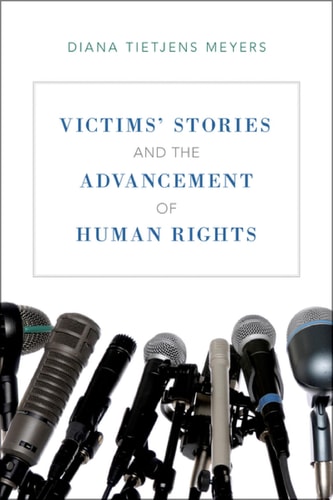
Victims' Stories and the Advancement of Human Rights
0
0
As an Amazon Associate and affiliate partner, Menrva Books earns from qualifying purchases. Learn more
Author Description
Victim's Stories and the Advancement of Human Rights takes on a set of questions suggested by the worldwide persistence of human rights abuse and the prevalence of victims' stories in human rights campaigns, truth commissions, and international criminal tribunals: What conceptions of victims are presumed in contemporary human rights discourse? How do conventional narrative templates fail victims of human rights abuse and resist raising novel human rights issues? What is empathy, and how can victims frame their stories to overcome empathetic obstacles and promote commitment to human rights? How can victims' stories be used ethically in the service of human rights? The book addresses these concerns by analyzing the rhetorical resources for and constraints on victims' ability to articulate their stories and by clarifying how their stories can contribute to enlarged understandings of human rights protections and deepened commitments to realizing human rights. It theorizes the normative content that victims' stories can convey and the bearing of that normative content on human rights. Throughout the book, published victims' stories-including stories of torture, slavery, genocide, rape in wartime, and child soldiering-are analyzed in conjunction with philosophical arguments. This book mobilizes philosophical theory to illuminate victims' stories and appeals to victims' stories to enrich the philosophy of human rights.
Menrva's Summary
THE THESIS
This book investigates how the narratives of human rights abuse victims function within contemporary discourse and how these accounts can be ethically utilized to advance global human rights protections. Diana T. Meyers, a philosopher specializing in ethics and political theory, examines the intersection of personal testimony and normative human rights frameworks. She argues that conventional narrative structures often limit the impact of victim testimony and proposes a new methodology for framing these stories to foster genuine empathy and political commitment.
THE SCOPE MAP
What You Will Find
- Philosophical analysis of the rhetorical constraints placed on victim narratives.
- A framework for evaluating the normative content within personal accounts of trauma.
- Case studies involving torture, slavery, genocide, wartime rape, and child soldiering.
- Ethical guidelines for the use of victim testimony in international tribunals and truth commissions.
Scope Limits
- The text does not provide a comprehensive history of specific human rights organizations.
- It does not offer a legal manual for practitioners but focuses on the philosophical and rhetorical dimensions of testimony.
THE AUTHORITY PERSPECTIVE
Scholars and human rights practitioners frequently cite this work as a significant contribution to the philosophy of human rights and narrative ethics. Readers often note the academic density of the prose, which requires a strong background in philosophical theory to fully appreciate the author's arguments.
Page Count:
274
Publication Date:
2016-01-01
Publisher:
Oxford University Press
ISBN-10:
0190613777
ISBN-13:
9780190613778
Philosophy
Sociology
Woman Studies
Professional Career & Trade
Victims of crimes
Social justice
Ethics
Human rights
Community Tags
Similar Books