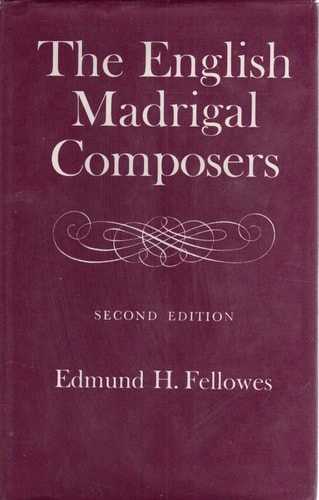
The English Madrigal Composers
0
0
As an Amazon Associate and affiliate partner, Menrva Books earns from qualifying purchases. Learn more
Author Description
This is the first comprehensive study of the madrigal as a musical form, a detailed study of the Elizabethan madrigal, and a critical survey of the composers of the period. Part I -- The English madrigal in relation to other forms of choral song -- The prolonged neglect of the madrigal -- English preference for vocal music -- The origin of the English madrigal school -- Etymology and use of the term madrigal -- Elizabethan madrigals and kindred contemporary art forms -- The part-books and the voices employed -- Title-pages, patrons, and printers of the original editions -- Some technical features of the notation -- The methods and idioms -- Rhythm and barring -- The madrigal lyrics. Part II -- Byrd -- Morley -- Weelkes -- Wilbye -- John Mundy, George Kirbye, Nathaniel Pattrick, William Holborne, Giles Farnaby, Michael Cavendish, John Farmer, John Bennet, the Oriana composers -- Richard Carlton, Michael East, Thomas Bateson, Thomas Greaves, Richard Alison, Robert Jones, Henry Youll, Thomas Ravenscroft, Orlando Gibbons -- John Ward, Francis Pilkington, Henry Lichfield, Thomas Vautor, Martin Peerson, Thomas Tomkins, John Hilton, Peter Philips -- The English lutenists -- Appendices. Edmund Horace Fellowes CH MVO (1870-1951), was a clergyman and scholar known for his work in promoting the revival of 16th- and 17th-century English music. He carried out a voluntary labor of considerable importance by cataloguing the prints and manuscripts in the library of St Michael's College, Tenbury Wells, of which he was honorary librarian (1918-48). Fellowes' editions of Tudor church music represent an incalculable contribution to musical scholarship, making the music accessible to composers and scholars, notably Vaughan Williams, whose English Hymnal was influenced by study of Fellowes' editions. Fellowes lectured extensively on the subject, travelling numerous times to the States for this his was the foremost work in the Anglican Tudor revival of the early 20th century.
Menrva's Summary
THE THESIS
This work investigates the historical development, technical structure, and artistic significance of the English madrigal during the Elizabethan era. Edmund H. Fellowes, a prominent clergyman and scholar of 16th- and 17th-century music, utilizes his extensive archival research and cataloging experience to establish a framework for understanding the madrigal school. He argues that the English madrigal represents a distinct and vital evolution of choral song, necessitating a critical survey of the composers who defined the period's musical landscape.
THE SCOPE MAP
What You Will Find
- A comprehensive analysis of the etymology, notation, and rhythmic idioms of the madrigal form.
- Detailed biographical and critical profiles of major composers including Byrd, Morley, Weelkes, and Wilbye.
- Examination of the relationship between madrigal lyrics and contemporary choral art forms.
Scope Limits
- The text focuses primarily on the English school and does not provide an exhaustive comparative study of continental European madrigal traditions.
- It does not offer modern performance practice instructions beyond the historical context provided.
THE AUTHORITY PERSPECTIVE
Experts recognize this volume as a foundational text for the 20th-century revival of Tudor music. Readers frequently note the academic density of the prose, which serves as a primary reference for musicologists and historians studying the Anglican Tudor period.
Page Count:
364
Publication Date:
1975-01-01
Publisher:
Oxford Press
ISBN-10:
0193151448
ISBN-13:
9780193151444
Biography
Music
History
Musical Genres
Music theory
Musicology
Music History
Performance theory
Biographical Study
Community Tags
Similar Books