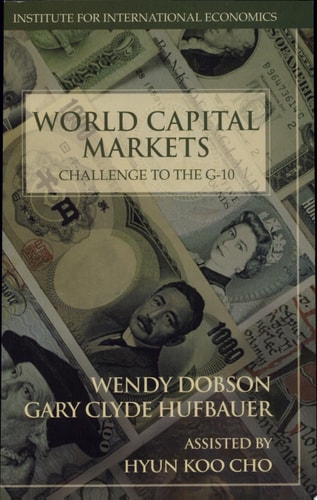
World Capital Markets Challenge to the G-10
0
0
As an Amazon Associate and affiliate partner, Menrva Books earns from qualifying purchases. Learn more
Author Description
It is often pointed out that "for every bad borrower, and for every failed project, there is also a culpable lender or investor." This observation is particularly apt for the debate now raging in the capital markets: should private bankers and investment managers bear a greater share of the costs when financial crises erupt in emerging economies? Critics who have analyzed the "plumbing" of the world's financial architecture have thus far devoted enormous attention to the demand side--structural weaknesses in emerging markets. They have excoriated the IMF for ineptitude and policy mistakes. But the authors of this study argue that financial leaders of the G-10 nations (industrial nations that were hardly affected by the crises of 1997-98) owe a responsibility--both to their own citizens and the emerging markets--to take a far more vigilant stance. Dobson and Hufbauer criticize the supply side of world capital markets and ask how G-10 capital suppliers can reform their own financial systems to make the world safe for large-scale international capital flows. They draw a comprehensive picture of international finance through an extensive review of capital flows, the major financial players behind these flows, and the balance between costs and benefits of international capital movements. The authors analyze the implications of changing the rules of the game and recommend specific policy measures.
Menrva's Summary
THE THESIS
This study investigates the responsibility of G-10 nations' financial leaders in mitigating financial crises within emerging economies. The authors argue that while much attention has focused on the demand side (structural weaknesses in emerging markets) and the IMF's role, the supply side—the G-10 capital suppliers—also bears significant responsibility. They contend that G-10 nations owe a duty to their own citizens and to emerging markets to adopt a more vigilant stance. The book examines how G-10 capital suppliers can reform their financial systems to ensure the safety of large-scale international capital flows.
THE SCOPE MAP
- Analysis of the demand side of capital markets, focusing on structural weaknesses in emerging economies.
- Critique of the IMF's role, including perceived ineptitude and policy mistakes.
- Examination of the supply side of world capital markets and the responsibilities of G-10 capital suppliers.
- Recommendations for reforming G-10 financial systems to secure international capital flows.
- Comprehensive overview of international finance, including capital flows and major financial players.
- Assessment of the balance between costs and benefits of international capital movements.
- Analysis of the implications of changing the rules governing international finance.
- Policy recommendations for enhancing stability in global capital markets.
THE AUTHORITY PERSPECTIVE
The book critically examines the role of G-10 nations in global financial stability, shifting focus from emerging market weaknesses to the responsibilities of capital suppliers. It argues for a more vigilant stance from G-10 financial leaders and proposes reforms to their own systems to safeguard international capital flows. The analysis covers the mechanics of international finance, the actors involved, and the cost-benefit dynamics of capital movements. The authors conclude by offering specific policy measures to improve global financial security.
Page Count:
251
Publication Date:
2001-01-01
Publisher:
Peterson Institute
ISBN-10:
0881323012
ISBN-13:
9780881323016
Economics
Non-Fiction
Business
Finance
International relations
Community Tags
Similar Books