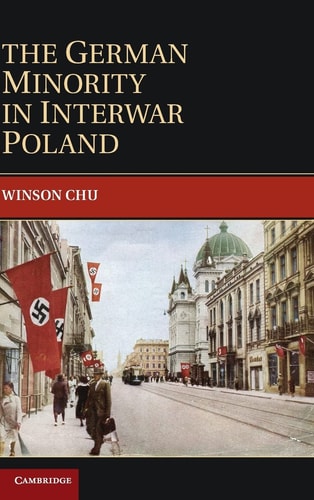
The German Minority in Interwar Poland
0
0
As an Amazon Associate and affiliate partner, Menrva Books earns from qualifying purchases. Learn more
Author Description
The German Minority in Interwar Poland analyzes what happened when Germans from three different empires - the Russian, Habsburg, and German - were forced to live together in one new state. After the First World War, German national activists made regional distinctions among these Germans and German-speakers in Poland, with preference initially for those who had once lived in the German Empire. Rather than becoming more cohesive over time, Poland's ethnic Germans remained divided and did not unite within a single representative organization. Polish repressive policies and unequal subsidies from the German state exacerbated these differences, while National Socialism created new hierarchies and unleashed bitter intra-ethnic conflict among German minority leaders. Winson Chu challenges prevailing interpretations that German nationalism in the twentieth century viewed "Germans" as a single homogeneous group of people. His revealing study shows that nationalist agitation could divide as well as unite an embattled ethnicity.
Menrva's Summary
THE THESIS
This book investigates the complex and often fragmented identity of the German minority in interwar Poland. Winson Chu examines how Germans from three distinct imperial backgrounds—Russian, Habsburg, and German—navigated their existence within a newly formed Polish state. The study reveals that rather than coalescing into a unified group, Poland's ethnic Germans remained divided, influenced by regional distinctions and preferential treatment initially given to those from the former German Empire. Polish policies and German state subsidies further exacerbated these internal divisions, while the rise of National Socialism ignited bitter conflicts among minority leaders, challenging the notion of a monolithic German nationalism.
THE SCOPE MAP
- Analysis of the German minority in Poland between World War I and World War II.
- Examination of the distinctions among Germans from the Russian, Habsburg, and German empires.
- Exploration of the failure of ethnic Germans to unite under a single representative organization.
- Discussion of how Polish repressive policies and German state subsidies impacted minority cohesion.
- Investigation into the role of National Socialism in creating new hierarchies and intra-ethnic conflict.
- Challenge to prevailing interpretations of German nationalism as a homogeneous force.
- Demonstration of how nationalist agitation can divide an ethnicity.
THE AUTHORITY PERSPECTIVE
The book is recognized for its detailed analysis of the German minority in interwar Poland, particularly its challenge to the idea of a singular, cohesive German nationalism. Scholars have noted its exploration of how external policies and internal leadership struggles fragmented the ethnic German population. The study is valued for its nuanced perspective on the complexities of minority identity and the impact of political and ideological forces on ethnic groups. It provides a significant contribution to the understanding of interwar Eastern European history and the dynamics of nationalism.
Page Count:
320
Publication Date:
2012-06-25
Publisher:
Cambridge University Press
ISBN-10:
1107008301
ISBN-13:
9781107008304
Non-Fiction
History
Politics
Nationalism
Minority Studies
European History
Community Tags
Similar Books