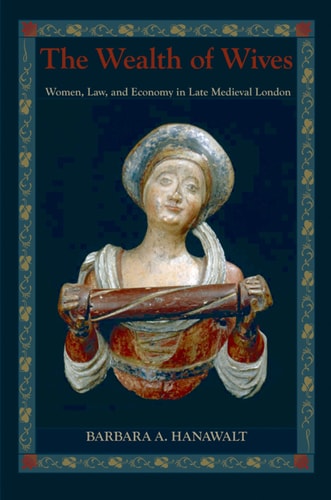
The Wealth of Wives: Women, Law, and Economy in Late Medieval London
0
0
As an Amazon Associate and affiliate partner, Menrva Books earns from qualifying purchases. Learn more
Author Description
London became an international center for import and export trade in the late Middle Ages. The export of wool, the development of luxury crafts and the redistribution of goods from the continent made London one of the leading commercial cities of Europe. While capital for these ventures came from a variety of sources, the recirculation of wealth through London women was important in providing both material and social capital for the growth of London's economy. A shrewd Venetian visiting England around 1500 commented about the concentration of wealth and property in women's hands. He reported that London law divided a testator's property three ways allowing a third to the wife for her life use, a third for immediate inheritance of the heirs, and a third for burial and the benefit of the testator's soul. Women inherited equally with men and widows had custody of the wealth of minor children. In a society in which marriage was assumed to be a natural state for women, London women married and remarried. Their wealth followed them in their marriages and was it was administered by subsequent husbands. This study, based on extensive use of primary source materials, shows that London's economic growth was in part due to the substantial wealth that women transmitted through marriage. The Italian visitor observed that London men, unlike Venetians, did not seek to establish long patrilineages discouraging women to remarry, but instead preferred to recirculate wealth through women. London's social structure, therefore, was horizontal, spreading wealth among guilds rather than lineages. The liquidity of wealth was important to a growing commercial society and women brought not only wealth but social prestige and trade skills as well into their marriages. But marriage was not the only economic activity of women. London law permitted women to trade in their own right as femmes soles and a number of women, many of them immigrants from the countryside, served as wage laborers. But L
Menrva's Summary
THE THESIS
This study investigates how the legal and social status of women in late medieval London facilitated the city's economic growth and the circulation of capital. Barbara A. Hanawalt, a historian specializing in medieval social history, utilizes extensive primary source materials—including wills, court records, and guild documents—to challenge traditional views of patrilineal wealth. She argues that London's unique legal framework allowed women to act as critical conduits for property and social prestige, thereby fostering a horizontal economic structure rather than a rigid, lineage-based one.
THE SCOPE MAP
What You Will Find
- Analysis of London's inheritance laws and the 'three-part' division of property.
- Examination of the 'femme sole' legal status allowing women to trade independently.
- Investigation into the role of widows in managing family wealth and minor children's inheritances.
- Comparison between London's horizontal wealth distribution and the patrilineal systems of other European cities like Venice.
Scope Limits
- The study focuses primarily on the economic and legal mechanisms within London and does not provide a comprehensive history of women's domestic lives outside of these commercial contexts.
THE AUTHORITY PERSPECTIVE
Historians and medievalists frequently cite this work as a foundational text for understanding the intersection of gender, law, and urban economics in the Middle Ages. Readers often note the academic density of the prose, which relies heavily on archival evidence to support its revisionist claims regarding the agency of medieval women.
Page Count:
331
Publication Date:
2007-01-01
Publisher:
Oxford University Press
ISBN-10:
0190295228
ISBN-13:
9780190295226
History
Great Britain
Womens History
Economic History
London History
Woman Studies
European History
Community Tags
Similar Books