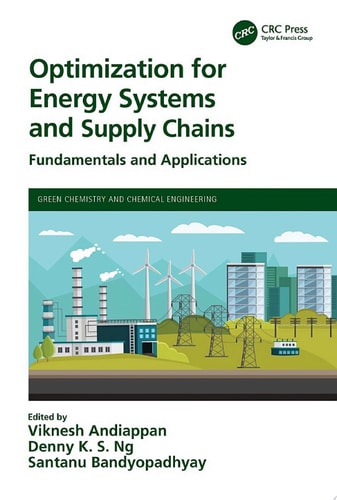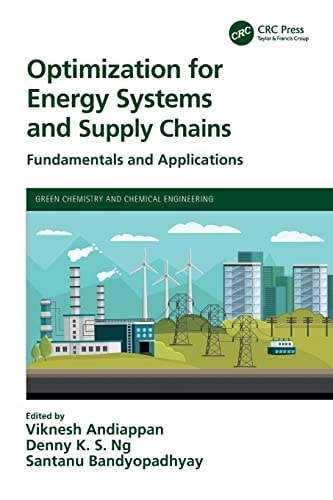
Optimization for Energy Systems and Supply Chains: Fundamentals and Applications
0
0
As an Amazon Associate and affiliate partner, Menrva Books earns from qualifying purchases. Learn more
Author Description
To curb the impacts of rising CO2 emissions, the Intergovernmental Panel on Climate Change report states that a net zero target needs to be achieved by the year 2055. Experts argue that this is a critical time to make important and accurate decisions. Thus, it is essential to have the right tools to efficiently plan and deploy future energy systems and supply chains. Mathematical models can provide decision-makers with the tools required to make well-informed decisions relating to development of energy systems and supply chains. This book provides an understanding of the various available energy systems, the basics behind mathematical models, the steps required to develop mathematical models, and examples/case studies where such models are applied. Divided into two parts, one covering basics for beginners and the other featuring contributed chapters offering illustrative examples, this book: Shows how mathematical models are applied to solve problems in energy systems and supply chains Provides fundamentals of the working principles of various energy systems and their technologies Offers basics of how to formulate and best practices for developing mathematical models, topics not covered in other titles Features a wide range of case studies Teaches readers to develop their own mathematical models to make decisions on energy systems This book is aimed at chemical, process, mechanical, and energy engineers.
Menrva's Summary
THE THESIS
This book addresses the critical need for effective mathematical models to guide decision-making in energy systems and supply chains amidst the global imperative to achieve net-zero emissions by 2055. The authors, experts in the field, present a comprehensive guide for engineers and decision-makers, detailing the fundamentals of various energy systems, the principles of mathematical modeling, and practical application through case studies. The book is structured into two parts: an introductory section for beginners and a section with contributed chapters showcasing real-world examples, aiming to equip readers with the tools to develop their own models for optimizing future energy infrastructure.
THE SCOPE MAP
- Fundamentals of various energy systems and their underlying technologies.
- Basics of mathematical model formulation and best practices for development.
- Application of mathematical models to solve problems in energy systems.
- Application of mathematical models to solve problems in supply chains.
- A wide range of case studies illustrating practical implementation.
- Guidance on developing personal mathematical models for decision-making.
- Targeted at chemical, process, mechanical, and energy engineers.
THE AUTHORITY PERSPECTIVE
The book is positioned as an essential resource for professionals grappling with the complexities of achieving net-zero targets, offering practical tools and foundational knowledge. Its dual structure, catering to both beginners and those seeking advanced examples, suggests a broad appeal within engineering disciplines. The emphasis on developing personal modeling capabilities indicates a focus on empowering readers to address specific challenges in energy systems and supply chains. The inclusion of diverse case studies aims to provide tangible insights into the application of mathematical optimization in real-world scenarios.
Page Count:
222
Publication Date:
2022-12-08
Publisher:
CRC Press
ISBN-10:
1032146222
ISBN-13:
9781032146225
Business
Non-Fiction
Science & Technology
Climate Change
Mathematical Modeling
Energy Systems
Engineering
Community Tags
Similar Books